

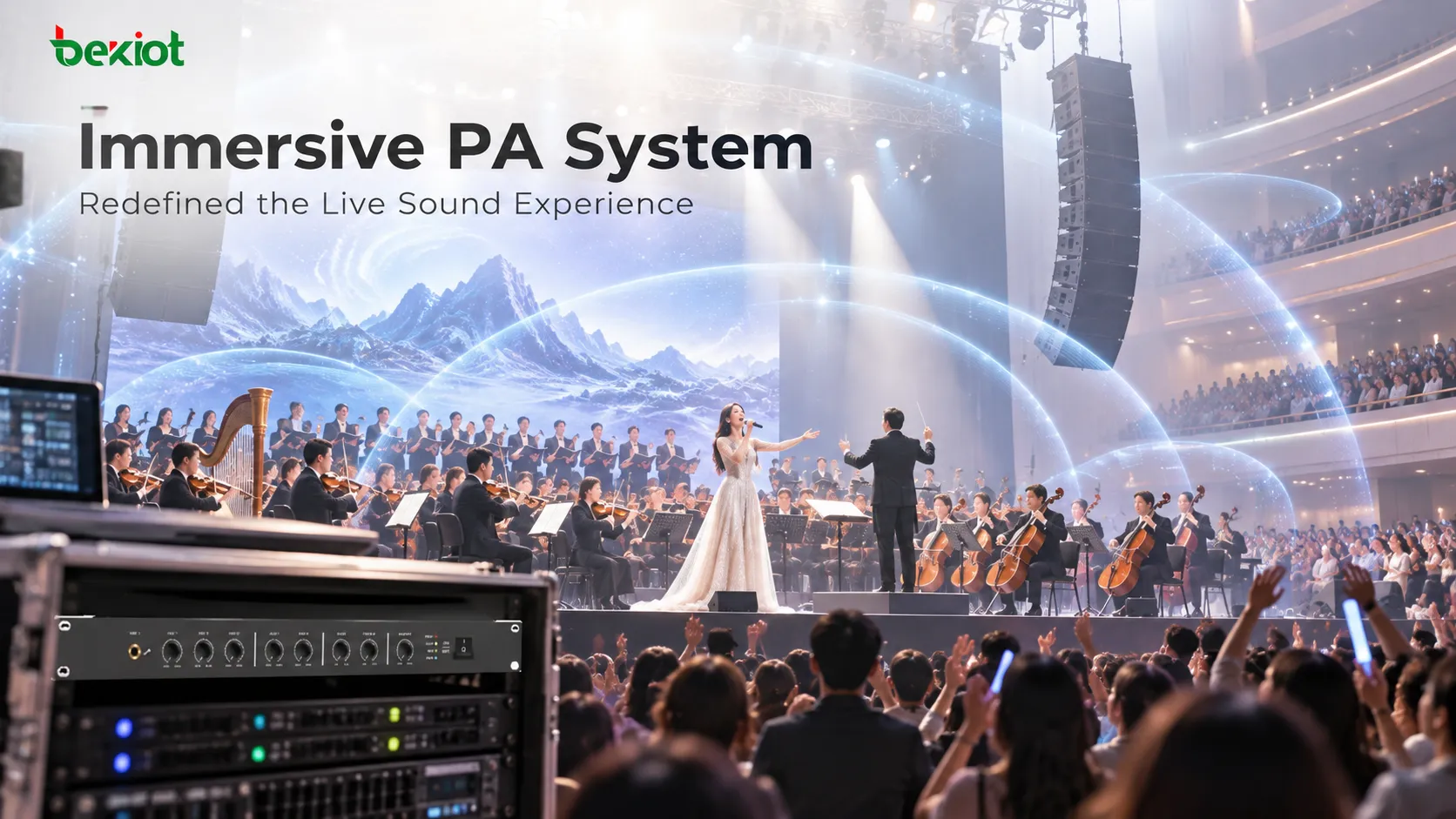
When a live production brings together a pop band, symphony orchestra, choir and multiple guest performers, the PA system carries a very specific responsibility: the quality of the entire show depends heavily on how well those sound sources are organized and reproduced. Every instrument occupies its own place, the lead vocal needs a stable and intelligible center image, while strings and choir sections need enough spatial separation to retain their scale. If dozens of sources are ultimately squeezed into a conventional left-right mix, a larger stage can easily result in a denser and less distinct sound field.
Smiley’s Armonie production in Bucharest pushed this challenge to a much larger scale. The show brought together Smiley, nine band members, six special guests, the 70-piece Metropolitan Orchestra and an 18-member choir, placing more than 100 musicians and singers on stage. Both performances sold out, but the production was notable for another reason: it became the first large-scale live show in Romania to be presented through an immersive PA system.
The significance of the production goes beyond the use of a new sound reinforcement technology. It demonstrates an approach that is becoming increasingly relevant in large live productions: sound reinforcement is no longer concerned only with level, frequency balance and left-right imaging. Source location, spatial movement, audience perception, stage monitoring, recording and broadcast routing can now be considered as parts of the same audio architecture.
The Challenge of Mixing More Than 100 Performers in Stereo
Conventional stereo live sound is generally built around left and right main PA systems, with Pan determining where a source sits between the two sides. The approach is mature and effective, and it remains entirely suitable for many bands and conventional live events.
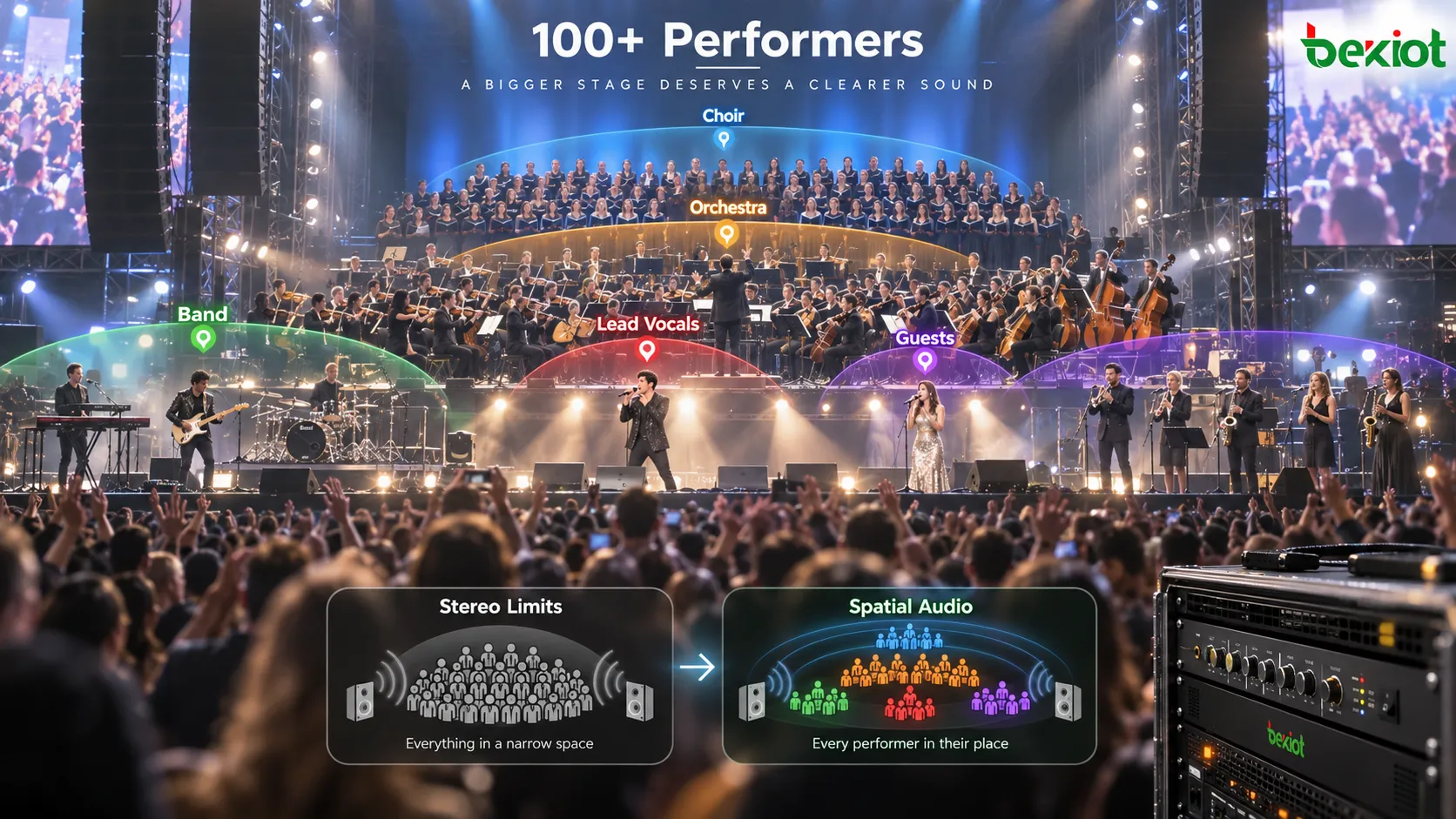
The limitations become more apparent when dozens of sound sources share the stage. A 70-piece orchestra already contains multiple string, woodwind, brass and percussion sections. Add a pop band, an 18-member choir, lead vocals, guest performers and playback tracks, and the FOH engineer must find space for a very large number of sources inside a relatively narrow stereo image.
When many instruments occupy similar left-right positions, the mix can still feel crowded even if frequency balance and levels are carefully controlled. The audience may hear every instrument, but it can become more difficult to identify where each source is coming from, while the natural spatial relationship between sections becomes compressed.
Audience position creates another limitation. Listeners near the center of the venue can usually experience a relatively coherent stereo image, while those seated closer to one side may hear the nearby main array much more strongly. A conventional Stereo Image therefore does not remain identical across the entire audience area.
This is where an immersive PA system can offer a different approach. Instead of reducing all musical information to a single Left/Right relationship, the system can create a closer connection between what the audience sees on stage and where those sources are perceived acoustically, while spreading complex musical elements across a more detailed spatial field.
Immersive PA Moves from Channel Mixing to Spatial Source Control
One of the most important differences between Immersive PA and conventional Stereo PA is the way the mix is conceptualized.
In a traditional live mix, the engineer mainly decides how much of a Channel should be sent to the left or right side. In a spatial audio system, an instrument, a section of the orchestra or a processed Group can retain more independent spatial properties. The spatial processor then renders those sources through the actual loudspeaker layout in the venue.
This approach is commonly described as Object-Based Mixing. An audio “object” can be understood as an independent source that carries both audio content and spatial information. In addition to level and tonal balance, the system can manage Pan, width, distance and, with suitable loudspeaker layouts, height or three-dimensional movement.
The Armonie production used L-Acoustics L-ISA for immersive PA processing. Rather than sending only a conventional Stereo Mix from FOH, processed buses for orchestra, band, choir, backing vocals and lead vocals were sent into the spatial audio stage. A total of 96 signals were transmitted from the FOH system to the L-ISA processor over MADI.
This architecture allows the engineer to treat “where a sound appears” as part of the musical presentation. Different instruments can be associated with corresponding positions on stage, while selected sections of the show can use automation to move sources through the sound field.
Continuous spatial movement is not automatically better. Lead vocals, featured instruments and orchestral sections often benefit more from stable and believable localization than from constant motion. Dynamic spatial effects are more useful when they serve specific musical moments. The Armonie team ultimately avoided heavy reliance on automated scenes and used Scene Automation only where it was impractical to adjust multiple Pan positions or Faders manually at the same time.
That decision highlights an important point: an immersive PA system does not mix the show automatically. Spatial audio expands the dimensions available to the engineer, but musical judgment still determines which sources should move, which should remain stable and how much spatial depth the audience should perceive.
High-Channel-Count FOH Handles Mixing and Spatial Routing
Once a live production reaches several hundred channels and signal paths, the FOH role extends far beyond creating a conventional Stereo Mix.
The Armonie production used an SSL Live L550 Plus at FOH. The console handled not only microphones and instruments from more than 100 performers, but also playback, effects, spatial audio buses, recording paths and broadcast outputs. With more than 512 Channels and Paths involved in the overall production, the real challenge was not simply having enough inputs; it was organizing those inputs in a way that remained manageable.
The initial plan included a highly detailed Show File with more than 250 Paths, extensive Snapshots, LTC and numerous effects. Two days before the performance, however, the FOH engineer simplified the structure. Some Channels were routed into Groups, the Groups were then sent to the L-ISA spatial processor, and Scene Automation was reserved for the few sections where too many simultaneous movements had to be managed manually.
This is a useful example of a broader live sound principle. A large digital console may provide enormous Processing Power, but having that processing available does not mean every function should be used at the same time. During a live show, the engineer still needs to locate a signal quickly, identify faults, rebalance musical sections and respond immediately to changes in the performance.
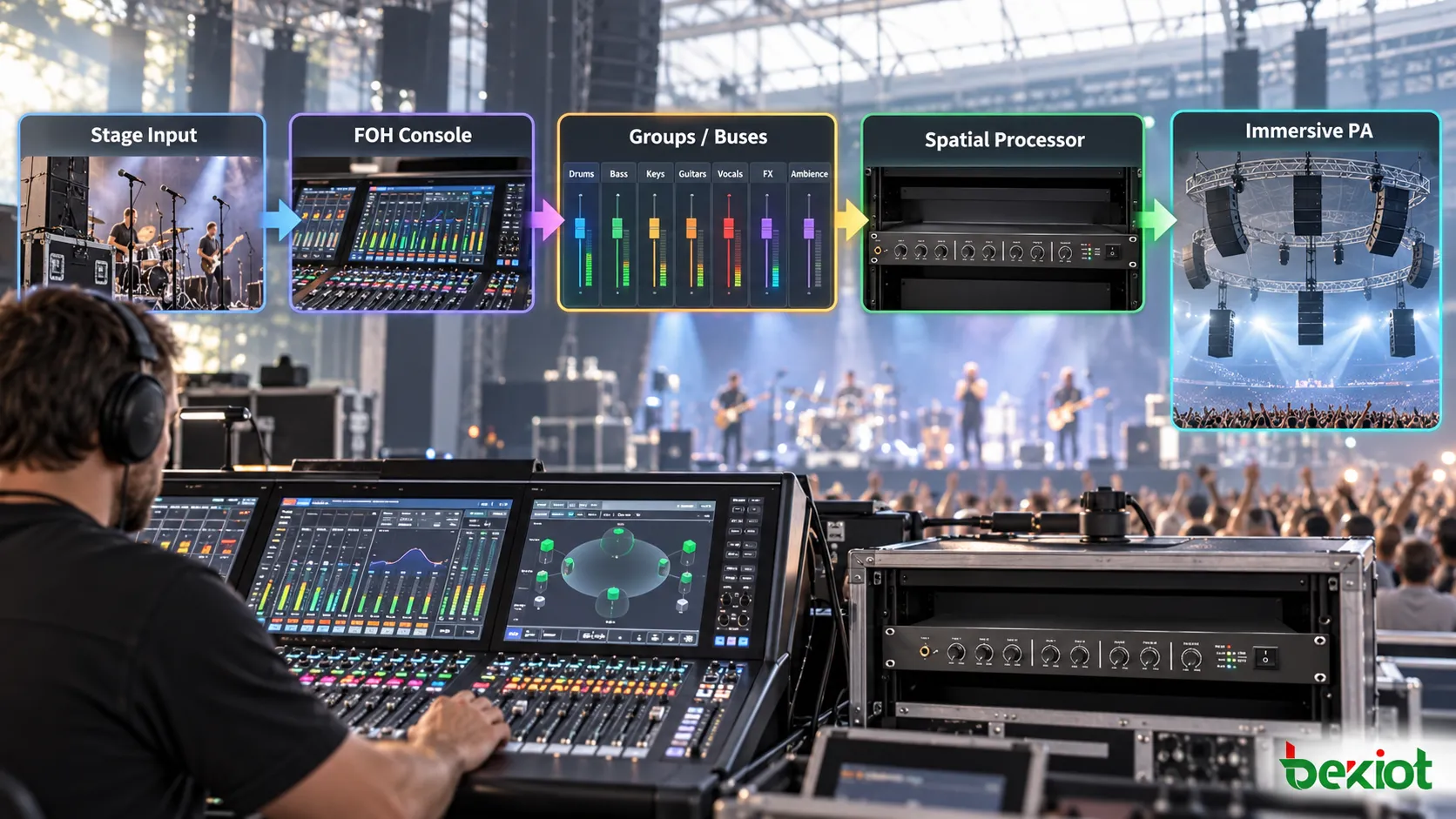
In an immersive system, manageability becomes even more important because spatial routing adds another layer to the signal chain. A single input may follow a path such as:
Stage Input → FOH Processing → Group / Bus → Spatial Processor → Immersive PA Loudspeaker System
If every stage becomes overly complex, troubleshooting can become difficult. A problem may originate from preamp gain, Channel processing, Group routing, the spatial processor or the final loudspeaker output.
A large Immersive PA system is therefore not simply a conventional system with dozens of additional outputs. It requires a clear signal hierarchy from the beginning so that music mixing and spatial rendering remain separate enough to manage, but closely linked enough to trace.
Monitoring, Recording and Broadcast Create Parallel Audio Paths
For the audience, the immersive PA field is the most obvious part of the system. For the production team, however, the main house mix is only one of several simultaneous audio paths.
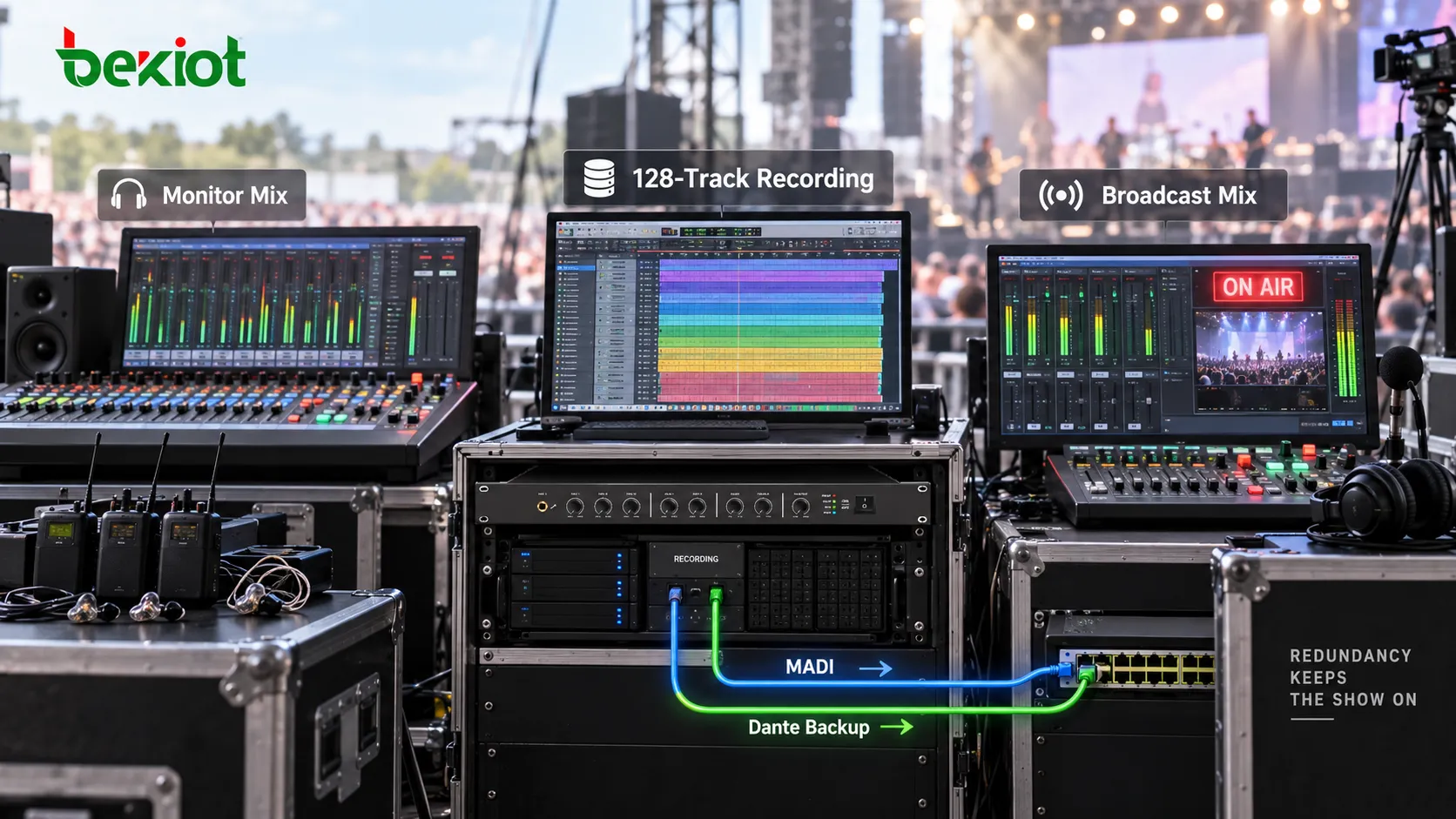
More than 100 performers on stage also needed monitoring. Armonie used a separate SSL L650 for the Monitor Mix. The band and guests occupied 24 monitor channels, while the orchestra used a personal monitoring system with more than 70 wireless beltpacks.
Separating FOH and monitor responsibilities prevents one console from having to serve two very different listening environments. The audience mix focuses on spatial localization, overall dynamics and musical balance. Performers on stage are more concerned with timing, their own instruments, the conductor and the specific sections they need to hear. The two Mixes serve different listeners and therefore have different priorities.
Recording created a third parallel path. The monitor console recorded 128 input channels at 96 kHz over MADI, preserving individual tracks instead of capturing only the final live Stereo Mix.
Television broadcast required another dedicated mix. ProTV participated in recording the production, so FOH generated a separate Stereo Broadcast Mix. Television viewers usually listen through stereo televisions, phones, laptops or headphones, which means the spatial balance designed for the venue cannot simply be copied directly into the broadcast feed.
A large immersive production therefore contains several parallel audio workflows:
The audience receives the immersive PA spatial mix;
Performers receive independent Monitor Mixes;
The recording system captures 128 multitrack channels;
The television production receives a dedicated Stereo Feed.
These workflows share many of the same stage sources, but they cannot simply use the same final Mix. This is one of the clear differences between a large Live Sound production and a conventional public address system: the same input may need to serve several completely different listening environments at the same time.
Immersive Listening Depends on Localization and Musical Relationships
The word “immersive” is often associated with more loudspeakers, stronger envelopment or sounds constantly moving around the audience. In live music, however, immersion does not depend only on dramatic effects.
A more natural form of immersion occurs when the audience sees an instrument or section at a particular position on stage and perceives the sound as coming from roughly the same place. When visual and auditory information align, individual instruments become easier to distinguish, and the apparent width and depth of the stage can feel more natural than in a conventional stereo presentation.
This is especially useful for a production combining an orchestra, band and choir. Strings do not need to occupy the same stereo position as every other accompaniment source, the choir can retain a suitable sense of width, and the lead vocal can maintain a stable center image. Spatial organization becomes a way of managing complex musical information rather than simply adding a special effect.
Spatial processing still cannot replace fundamental sound system design. Even if a source is positioned accurately, the listening experience will remain inconsistent if certain seats lack sufficient level, frequency response varies significantly, or arrival times between loudspeaker systems are poorly aligned.
Immersive PA therefore continues to depend on loudspeaker layout, coverage modeling, system calibration, delay alignment and consistency across the audience area. Object-Based Mixing determines where a source should appear and how it should move, while the loudspeaker system must translate that information into a stable acoustic field.
This is also what separates immersive PA from simply adding more speakers. More loudspeakers provide additional acoustic output positions, but without Spatial Processing, system design and a coherent mixing strategy, additional sources do not automatically create a better immersive experience.
Redundancy and Rapid Deployment Support a Complex Production
The Armonie production resulted in a two-hour performance, but the entire production team had less than 12 hours to complete Rigging, sound, lighting and video setup. For a system involving more than 512 signals and paths, two digital consoles, immersive processing, multitrack recording and broadcast feeds, setup time itself became a major engineering constraint.
Four SSL ML32.32 MADI Stageboxes were deployed on stage, together with a 32-input DAD Core256 for playback. These systems were connected through an SSL BLII Concentrator linking the FOH and Monitor Consoles. High-channel-count audio was primarily transported over MADI so that the different production departments could receive the signals they required.
A highly digital workflow also creates another risk: when a major transport link fails, the impact can be much wider than in a low-channel-count analog system.
To reduce that risk, the production team also used a Dante network as a Fallback Path for multitrack recording channels and the FOH playback device, with switching prepared through the console’s Signal Switcher. The significance is not simply that both MADI and Dante were used, but that the backup path reduced dependence on a single transport chain.
For large live productions, immersive effects only matter if the underlying system continues operating. Spatial Audio, automation and multitrack production can expand the artistic possibilities of the show, but advanced functionality should never come at the expense of basic reliability.
After two sold-out Armonie performances, the production is expected to continue developing as an immersive live experience. Its technical lessons extend beyond any one mixing console or spatial processor. As live production moves toward higher channel counts, spatial audio and simultaneous distribution to multiple content platforms, the PA system is evolving from a collection of sound reinforcement equipment into a real-time audio production architecture.
For the audience, the result may simply feel wider, more layered and more natural, with instruments appearing in believable positions and selected moments creating clear spatial movement. Behind that experience, however, FOH, Spatial Processing, Monitoring, Recording, Broadcast and Redundancy all have to work together.
FAQ
What Is an Immersive PA System?
An immersive PA system adds spatial audio processing and a multichannel loudspeaker layout to conventional live sound reinforcement, allowing individual sources to have more defined positions, width and movement. Some systems use Object-Based Mixing, where instruments or musical sections are treated as independent audio objects rather than being combined only into a traditional Left/Right Stereo Mix.
What Is the Difference Between Immersive PA and Stereo PA?
A conventional Stereo PA mainly distributes sources between left and right channels. An immersive PA system can use additional independent outputs and spatial processing to create a closer relationship between sound location and stage position, while also supporting more complex spatial movement. The result still depends on venue geometry, loudspeaker configuration and system design.
Does an Immersive PA System Always Need Surround and Overhead Speakers?
No. Immersive systems can use several different loudspeaker layouts. Some productions rely mainly on multiple frontal arrays to improve source localization, while others add side, rear or overhead loudspeakers to create a more complete three-dimensional field. The configuration should follow the artistic goals, venue structure and spatial audio requirements of the production.
What Does Object-Based Mixing Mean?
Object-Based Mixing keeps selected sound sources independent instead of combining them immediately into fixed output channels. Each audio object can carry spatial information such as position, width, distance or movement. A Spatial Processor then renders those objects through the available loudspeaker system.
Why Does an Immersive Production Still Need a Separate Monitor Console?
FOH primarily serves the audience, while the Monitor Mix serves musicians and singers on stage. Performers need timing references, their own instruments, the conductor and selected musical sections rather than a duplicate of the audience’s immersive sound field. Large productions therefore commonly separate FOH and Monitor responsibilities so that each Mix can be optimized independently.
Is Immersive PA Suitable for Every PA Application?
No. Immersive spatial audio is most relevant to concerts, theater productions, immersive events and other applications where spatialized sound contributes to the audience experience. School paging, factory announcements, transport information and emergency PA systems place greater emphasis on speech intelligibility, zoning, message priority and reliability, and generally do not require the additional complexity of an immersive sound system.