


A European customer wants a familiar local number, an employee traveling in Germany needs to answer the company line, and an Australian caller arrives after headquarters has closed. These are related problems of numbering, access and availability, rather than simply expensive international calls.
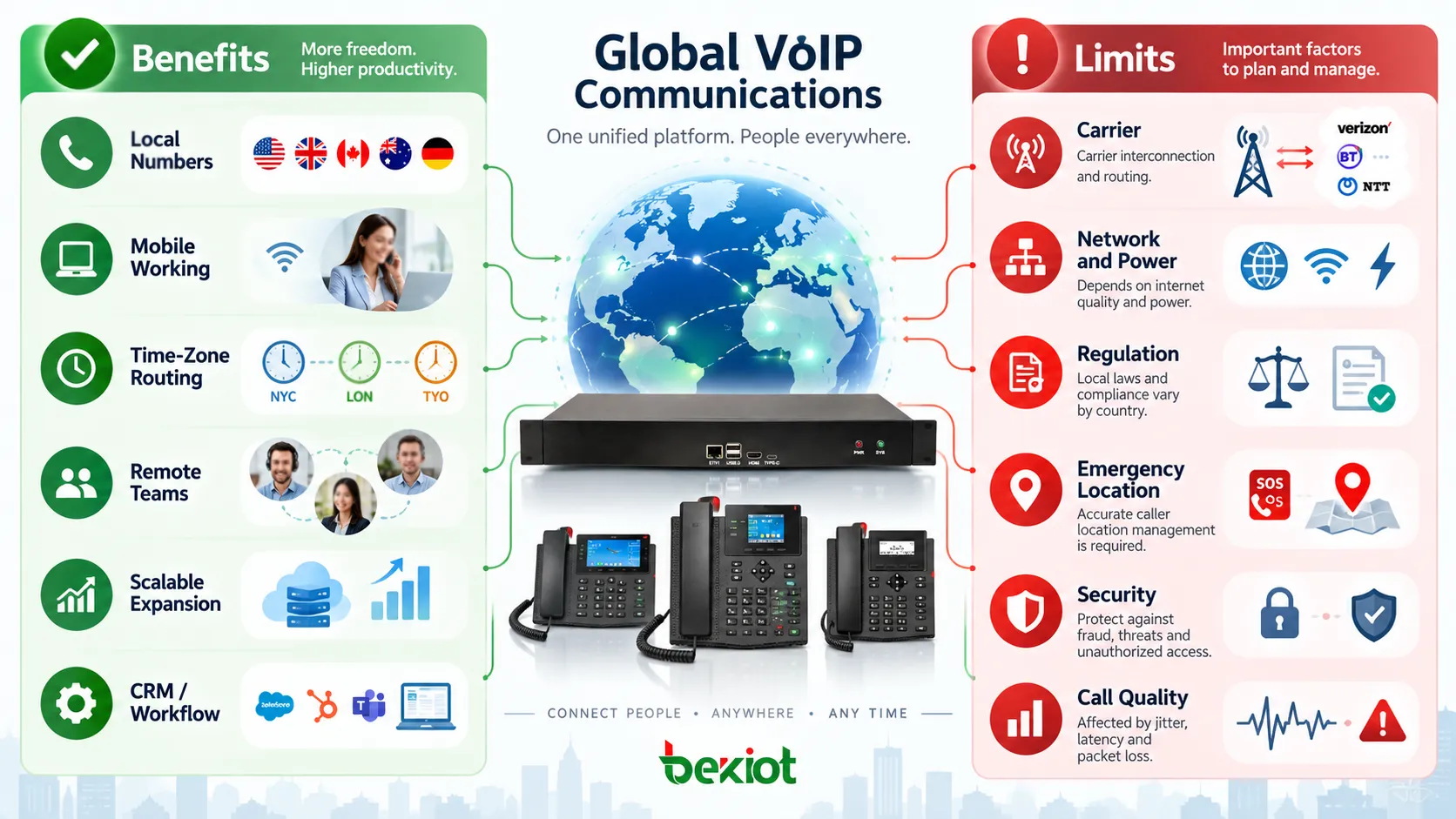
VoIP allows an IP PBX or communications platform to organize users, authorized devices and routing policies across locations. It can reduce communication friction, but it cannot provide worldwide numbers, uninterrupted service or regulatory compliance by itself. The practical question is which parts the platform controls and which still depend on carriers and local infrastructure.
Organize communication around people and services
A conventional office installation may tie a telephone number to a local line, PBX and desk extension. Opening another office can add a separate system, numbering plan and maintenance arrangement. Existing systems can also support networking and mobility; VoIP makes central administration easier where the selected architecture supports it.
SIP phones, desktop softphones, mobile applications and browser clients can share a business identity through a compatible platform. Browser access may require a WebRTC service or gateway; it is not an automatic feature of a SIP handset. The platform decides which devices ring, which queues users join and which outbound identity they may present.
Compare total cost, not only the minute rate
Internal calls can travel over a corporate WAN, VPN, private connection or cloud service instead of separate public telephone calls. Potential savings include fewer independent PBXs, simpler administration and less duplication of branch infrastructure. Internet access, platform subscriptions, licenses, maintenance and backup arrangements remain part of the cost.
Calls to ordinary fixed or mobile numbers still need a carrier or another PSTN interconnection service. International, premium-rate and toll-free charges depend on destination, number type and contract. A local number does not automatically make every call local-priced or free for the caller.
Regional carrier routes can improve cost and call completion when supported and permitted. For example, a UK team serving UK customers may use an authorized UK route. Confirm actual tariffs, permitted Caller ID, number formatting and call completion rather than assuming that the cheapest advertised rate is the best route.
Local numbers create entry points, not automatic local eligibility
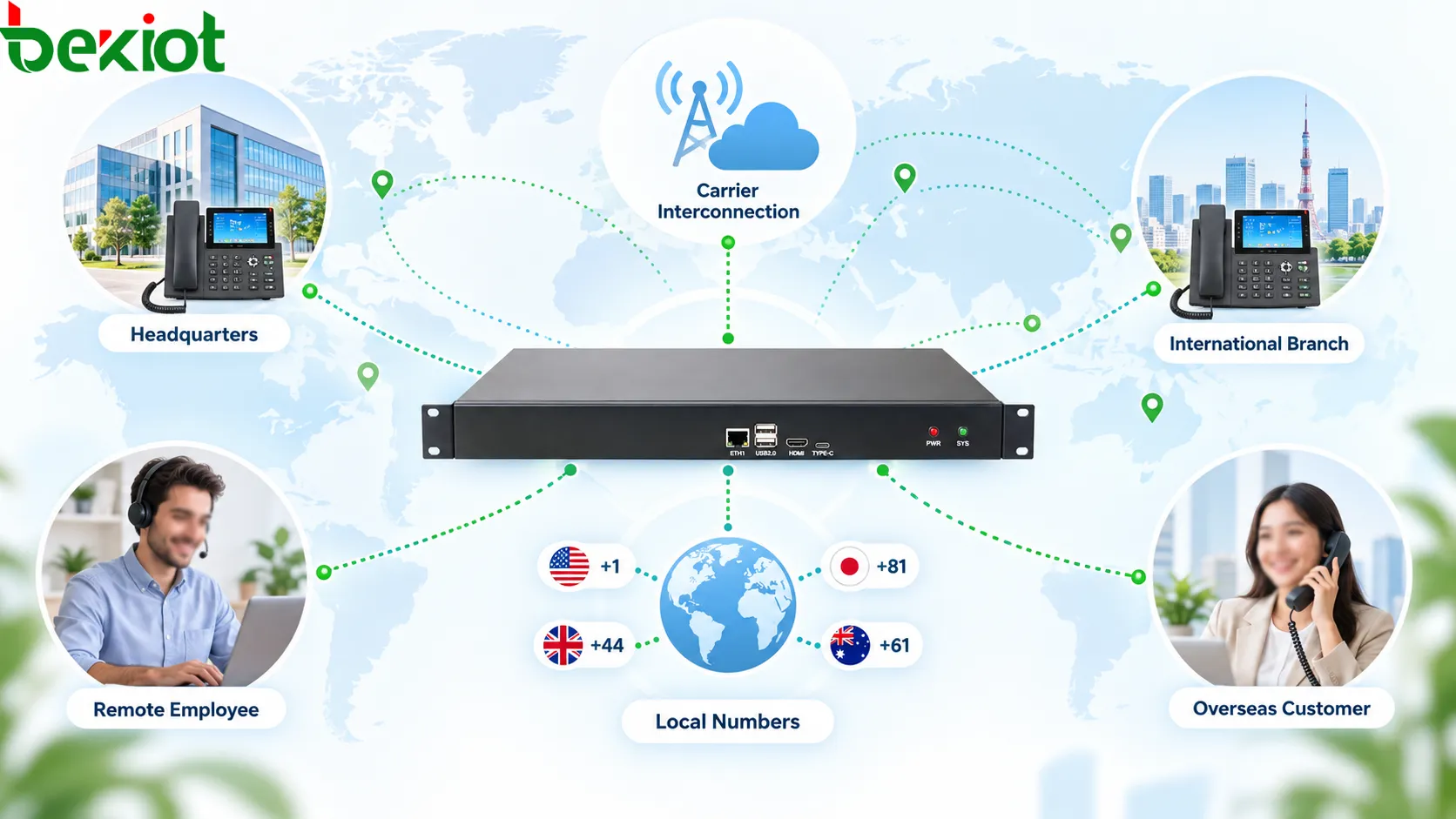
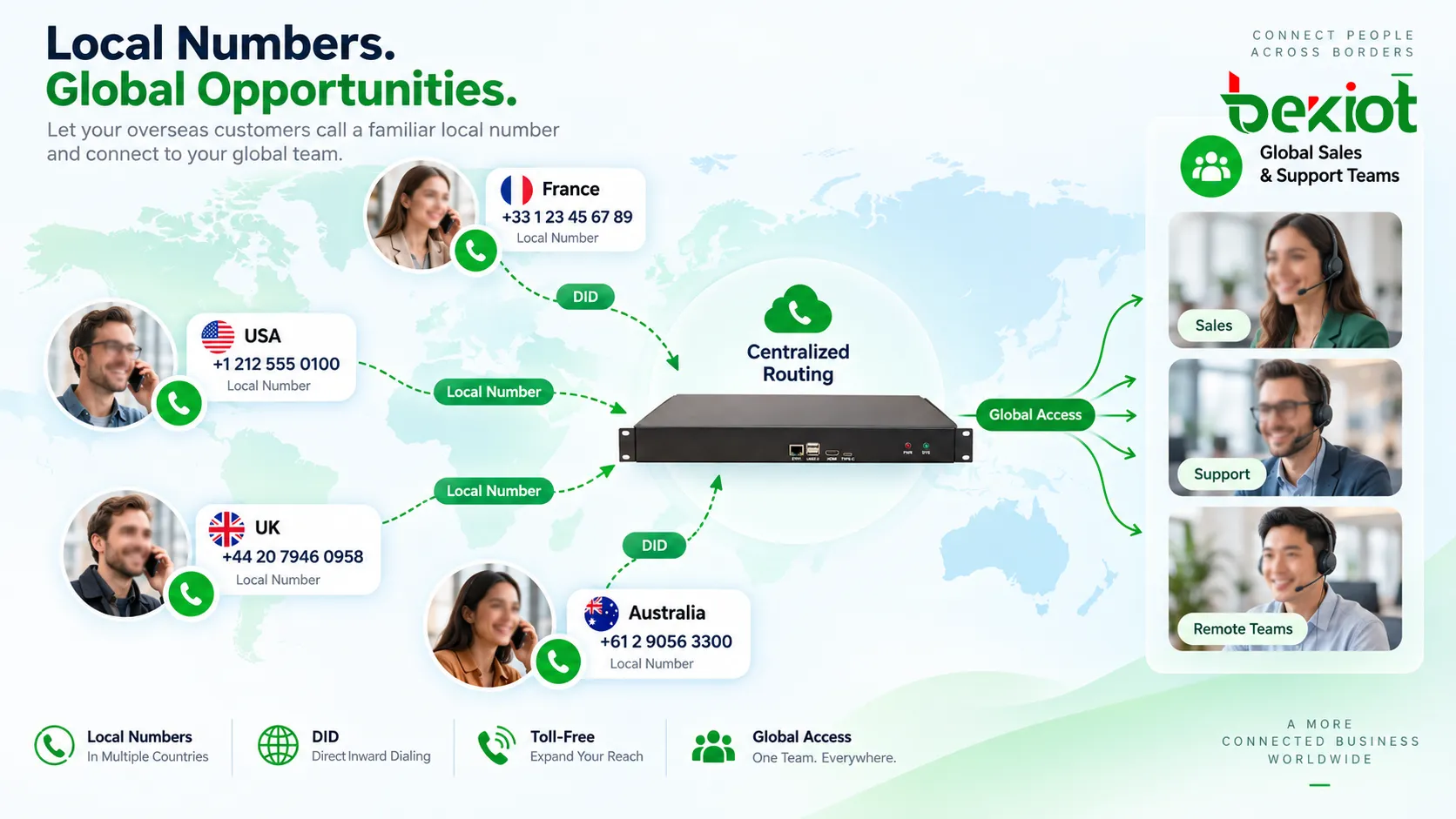
A platform can bring compatible local numbers, direct inward dialing numbers and toll-free services into one routing environment. A customer can dial a French number while an authorized service team elsewhere answers. A separate PBX behind every number is not always necessary.
Availability remains country- and number-specific. Local presence, identification, address verification or other documentation may be required. Numbering plans do not by themselves establish eligibility to buy a number. Confirm current requirements with the relevant authority and carrier, including any restrictions on cross-border use and number portability.
Keep the company identity when employees move
An authorized employee can often answer the company number from a supported softphone or mobile app instead of distributing a personal mobile number. Queue membership, missed calls and voicemail can follow the user where the platform supports them. The company should retain administrative control over accounts and numbers as staff change roles or leave.
Mobility depends on authentication, endpoint compatibility and network quality. Test office Wi-Fi, home broadband and mobile data separately. Moving an active call between networks may interrupt it, even when signing in from either network works. International use can also be limited by provider coverage, company policy and local requirements.
Coordinate service across time zones
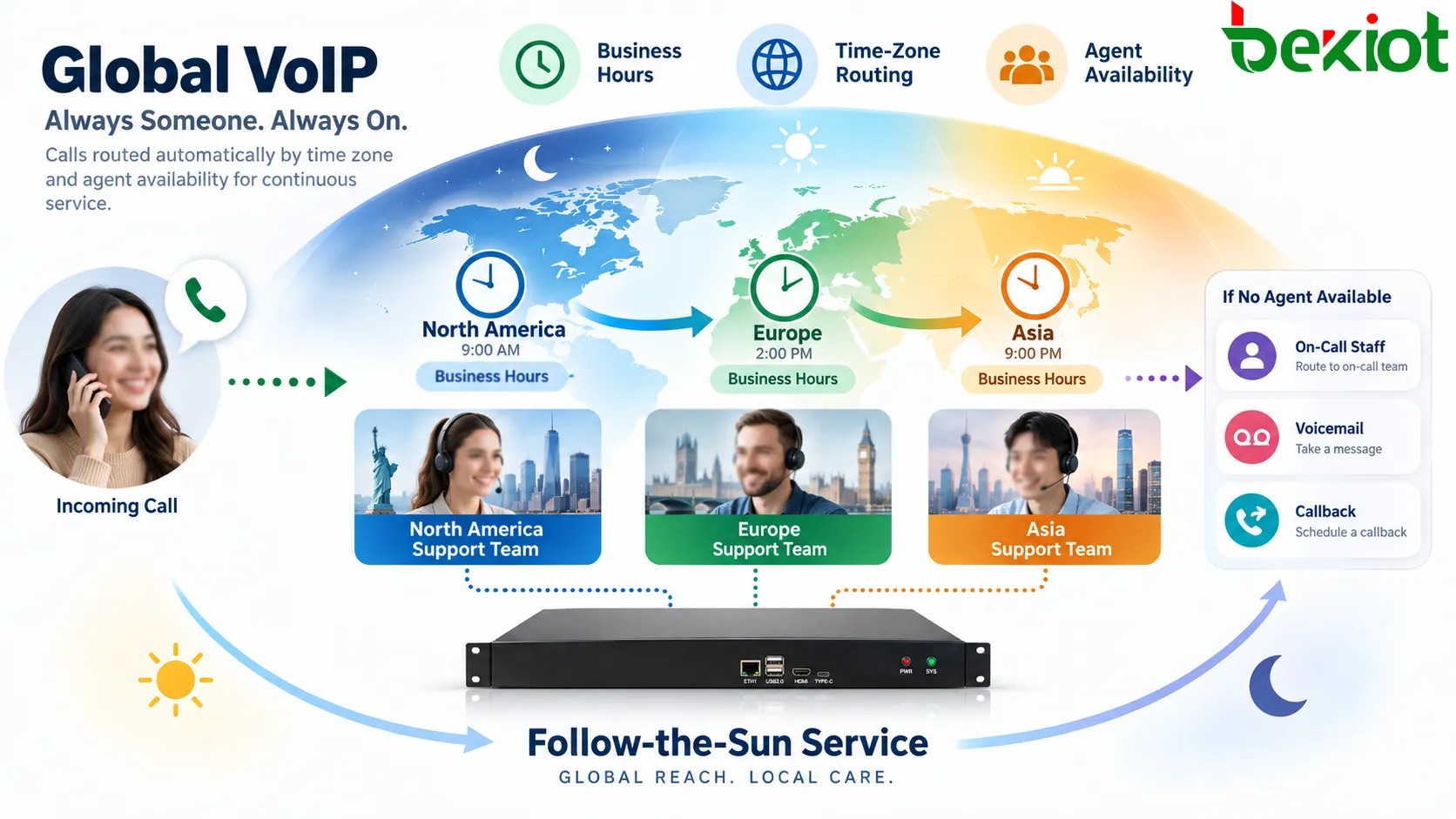
Business hours, named time zones, holidays, queue state, language and agent availability can be routing inputs. A follow-the-sun policy might send calls to Asia, then Europe, then North America as staffed teams become available. Daylight-saving changes and regional public holidays need explicit treatment.
When nobody is available, define an on-call route, voicemail or a callback workflow rather than sending calls repeatedly between closed queues. Routing cannot create staff capacity or language coverage. Test overlapping shifts, queue overflow, unanswered transfers and the experience of callers waiting across a shift change.
AI-based language detection, summaries or intent routing may be separate licensed or integrated services. They are optional additions to an operating model built on maintained schedules, permissions, queues and clear ownership of unanswered calls.
Expand without duplicating every voice system
A centrally managed deployment may add users, numbers and compatible endpoints without installing another complete voice core. A small overseas team can test demand and grow gradually. Administrators can also reclaim accounts, permissions and numbers when a project ends.
Centralization does not eliminate local equipment. Analog phones may need gateways, sites may require survivable call control, and local carriers or emergency arrangements may remain necessary. Check seat limits, concurrent calls, bandwidth, license capacity and support coverage before treating expansion as a configuration task.
Connect the work before and after the call
A CRM integration can display a customer record, attach call notes or create a follow-up task. Voicemail notifications and transcription can help teams hand over work between regions. Recording, messaging and video may also be available through the wider platform.
These are platform or integration capabilities, rather than functions guaranteed by VoIP or an individual telephone. Specify the actual application, interface, license and data flow. Caller-number matching is not proof of identity; recordings, transcripts and customer records also need appropriate access, retention and privacy controls.
The limits that remain after voice moves to IP
Carrier interconnection remains necessary for public telephone destinations. Document who supplies each number, which routes carry inbound and outbound calls, and who handles an outage or a porting dispute. Keep ownership and port-out arrangements clear before cancelling the old service.
Network and power failures can affect endpoints, PoE switches, routers, WAN links and call-control services. UPS protection for the server alone is insufficient. Dual access links or mobile backup help only if the remaining power, routing and service dependencies also work; test the complete fallback path.
Location is a separate emergency-calling requirement. A softphone can retain an office number after its user moves home or abroad. That number or its registered office address may not reveal the current location. Confirm supported emergency destinations, location updates and fallback instructions for each operating region.
Latency, jitter, packet loss and congestion affect voice quality. QoS can help on networks the organization controls, but cannot guarantee prioritization across the public Internet. Choose codecs and capacity for the expected conditions and measure representative calls, including busy periods and backup connections.
Security needs account controls, maintained software, restricted administration, appropriate SIP boundaries, encryption where supported and monitored call permissions. TLS and SRTP protect different parts of the communication path; neither prevents an authorized but compromised account from making expensive calls. Local recording, retention and cross-border data rules also require market-specific review.
Verify the operating model before deployment
Test inbound local numbers from the actual public networks customers use. Confirm the answering team, displayed identity, language, opening hours and fallback behavior. Verify outbound call completion, permitted Caller ID and billed charges in each target market. For migrations, confirm portability, authority over the number, transition timing and rollback responsibilities.
Test remote access and scheduled routing with real endpoints. Include daylight-saving changes, regional holidays, no-agent conditions and handover between teams. Check the promised CRM, transcription or recording workflow in the purchased configuration rather than relying on a generic feature list.
Run agreed failure tests for the primary access link, relevant power supplies and call-control availability. Arrange emergency-call verification with the provider or responsible authority using approved test procedures; do not place uncoordinated test calls to emergency services. Document recovery steps, support ownership and remaining limitations.
For a Becke Telcom proposal, map each requirement to the specified phone, IP PBX, gateway or integrated platform and its documented configuration. Central numbering, mobility and regional routing should be demonstrated as an end-to-end solution. The useful outcome is dependable access for customers and staff within known technical and local constraints.
FAQs
Can a business obtain a local number without an office in that country?
Sometimes. Eligibility varies by jurisdiction and number type, and may require local presence or supporting documents. Check the current rules and carrier conditions before designing the service around a particular number.
Can international numbers always be ported to another provider?
No. Portability depends on the country, number type and participating providers. Confirm who holds the number, whether port-out is supported and how incoming service will be protected during the transition.
Can global VoIP replace mobile phones and SIM cards?
Usually it complements them. Local mobile services still provide wireless access, data, SMS and other regional capabilities. A mobile app also needs a working data connection, compatible equipment and the required calling support.
Can an employee use the company softphone in another country?
Often technically possible, but successful sign-in is insufficient evidence. Verify permitted number use, Caller ID, call quality, emergency support, data handling and applicable local restrictions before relying on it.
Technical references
ITU national numbering plans: country-specific numbering information supplied by administrations.
IETF RFC 3261: SIP registration, routing and signaling-security foundations.