

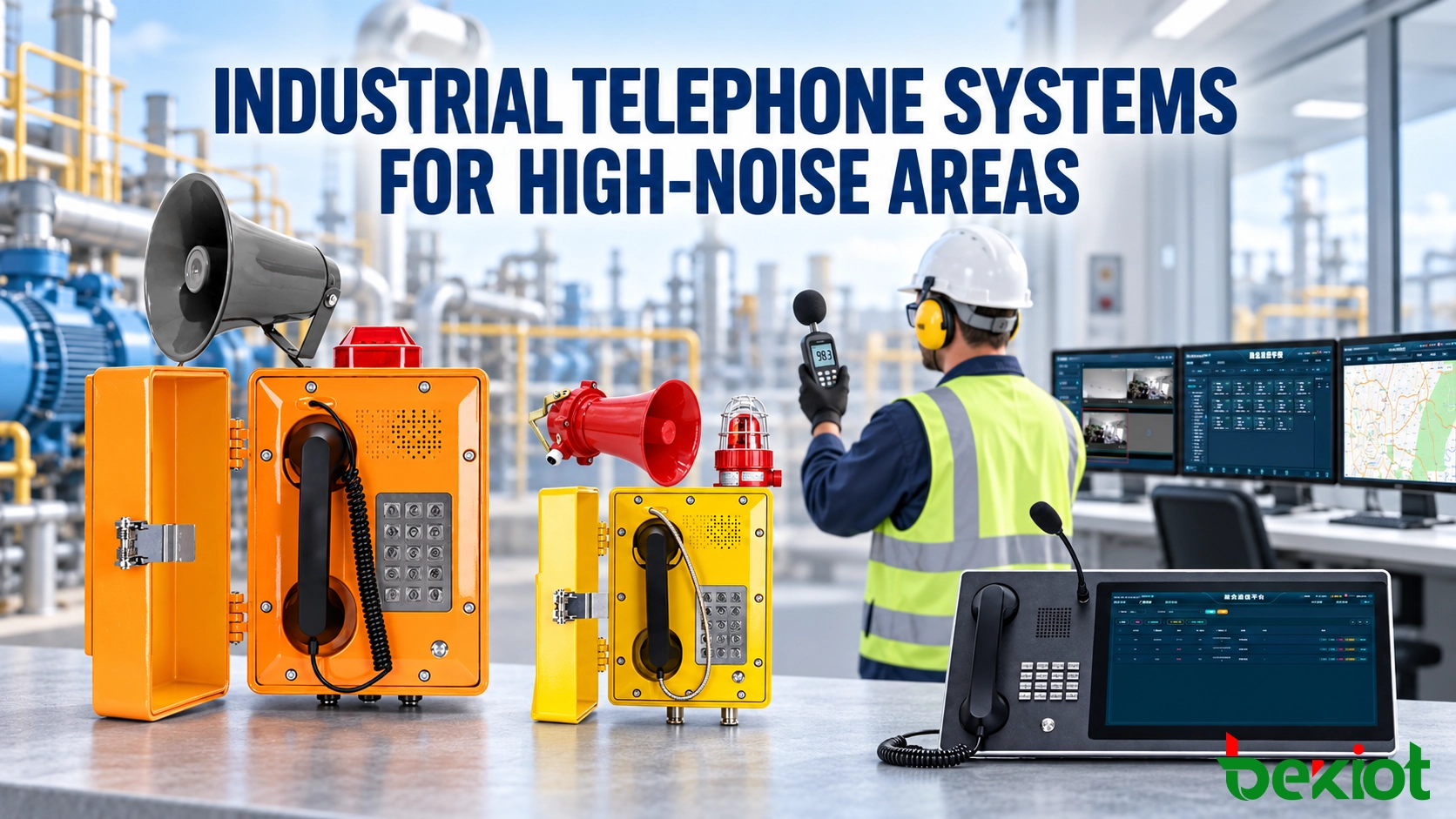
Machinery, ventilation, compressors and vehicle movements can mask ringing and speech. A useful industrial telephone system must let workers notice calls, understand instructions and reach an operator under real operating conditions. This depends on the whole path: acoustic interface, installation position, cabling, network, call control and dispatch.
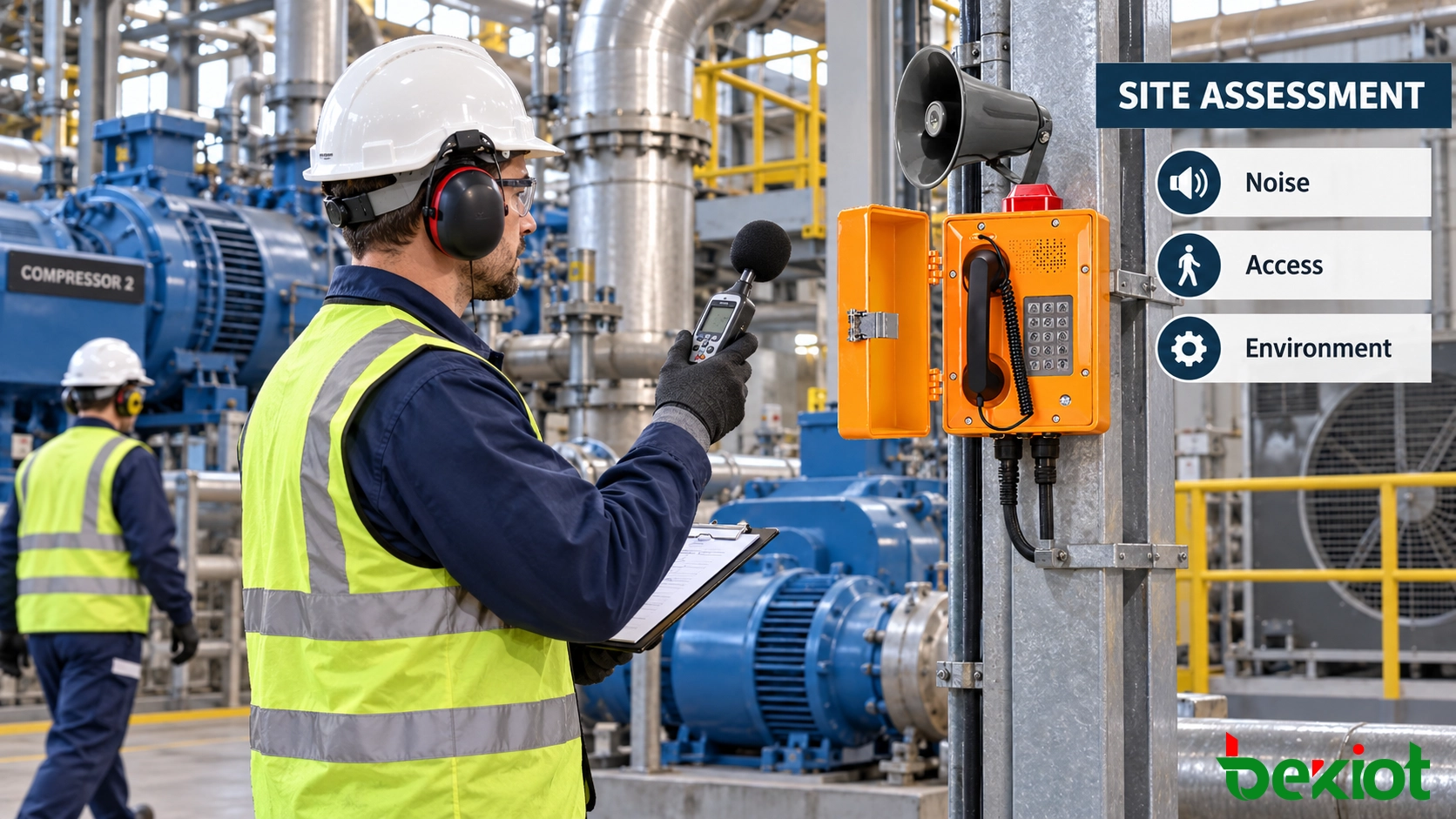
Begin with an Acoustic and Operational Survey
Measure representative production, peak activity, startup and maintenance conditions. Record average and peak noise, frequency content, intermittent impacts and reverberation; an idle-machine reading or one overall sound level cannot describe every communication problem.
Record the listening position, mouth-to-microphone distance and normal worker movements.
Identify helmets, gloves, hearing protection and respirators, including their effect on operation.
Map access routes, travel time, barriers and routine or emergency calling tasks.
Assess dust, water, chemicals, corrosion, vibration, temperature and electromagnetic exposure.
Separate three acceptance questions: is the incoming alert detectable, is speech intelligible in both directions, and is the user's noise exposure controlled? A louder ring does not prove understandable speech or hearing safety. There is no single signal-to-noise margin that guarantees all three across different noise spectra, users and protective equipment.
Translate Site Conditions into Terminal Requirements
Handset, Hands-Free and Hearing Protection
A close-talking handset can improve speech pickup and listening compared with a distant microphone and speaker. Hands-free operation can help users whose hands are occupied, but needs testing for microphone distance, directionality, echo and reflected sound. A sheltered position, acoustic hood or booth may help when safely installed.
Test the complete arrangement with the hearing protection actually required. Do not remove earplugs, lift earmuffs or break their seal to make a call. An approved communication headset may be appropriate where compatible with the task and any hazardous-area requirements. HSE and NIOSH guidance both emphasize selecting protection that fits the work and communication needs.
Incoming Notification and Speech Levels
Check ringing at normal work positions while machinery runs. Combine sound with a suitably positioned beacon, strobe or display where needed; verify visibility through obstacles and in site lighting. Coordinate signals with existing alarms so workers recognize their meaning.
Set microphone gain to capture speech without clipping or excessive background noise. Evaluate noise-reduction processing with real instructions because processing can also affect speech. Adjust receiver and speaker levels for production and quieter maintenance periods; maximum amplification can cause distortion and additional exposure.
Environmental and Hazardous-Area Protection
Specify ingress, impact, corrosion, temperature and chemical resistance separately. Rain protection does not establish suitability for pressurized washdown or cleaning chemicals. Check cords, hook switches, mounting hardware, cable entries and unused openings as well as the enclosure.
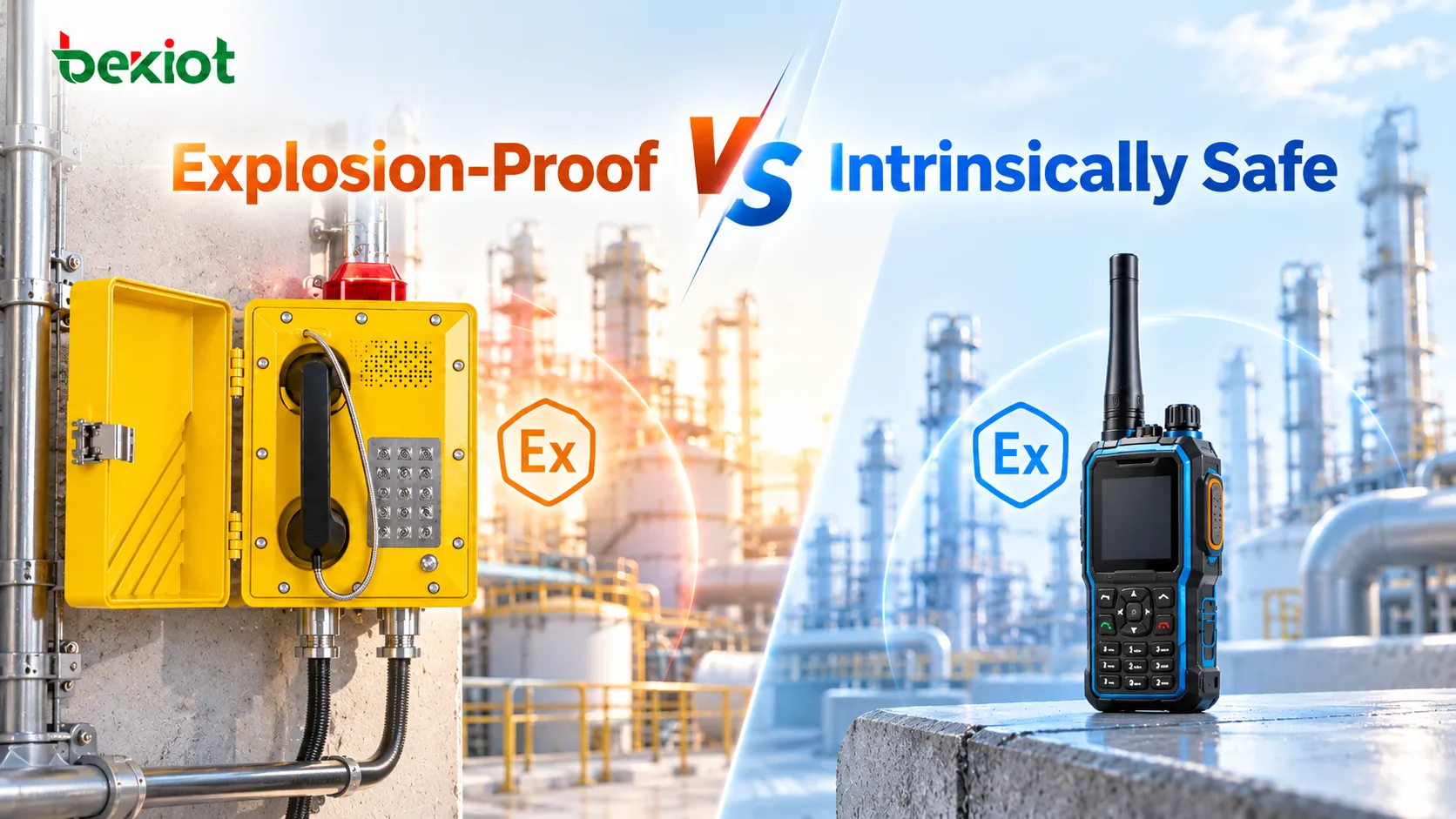
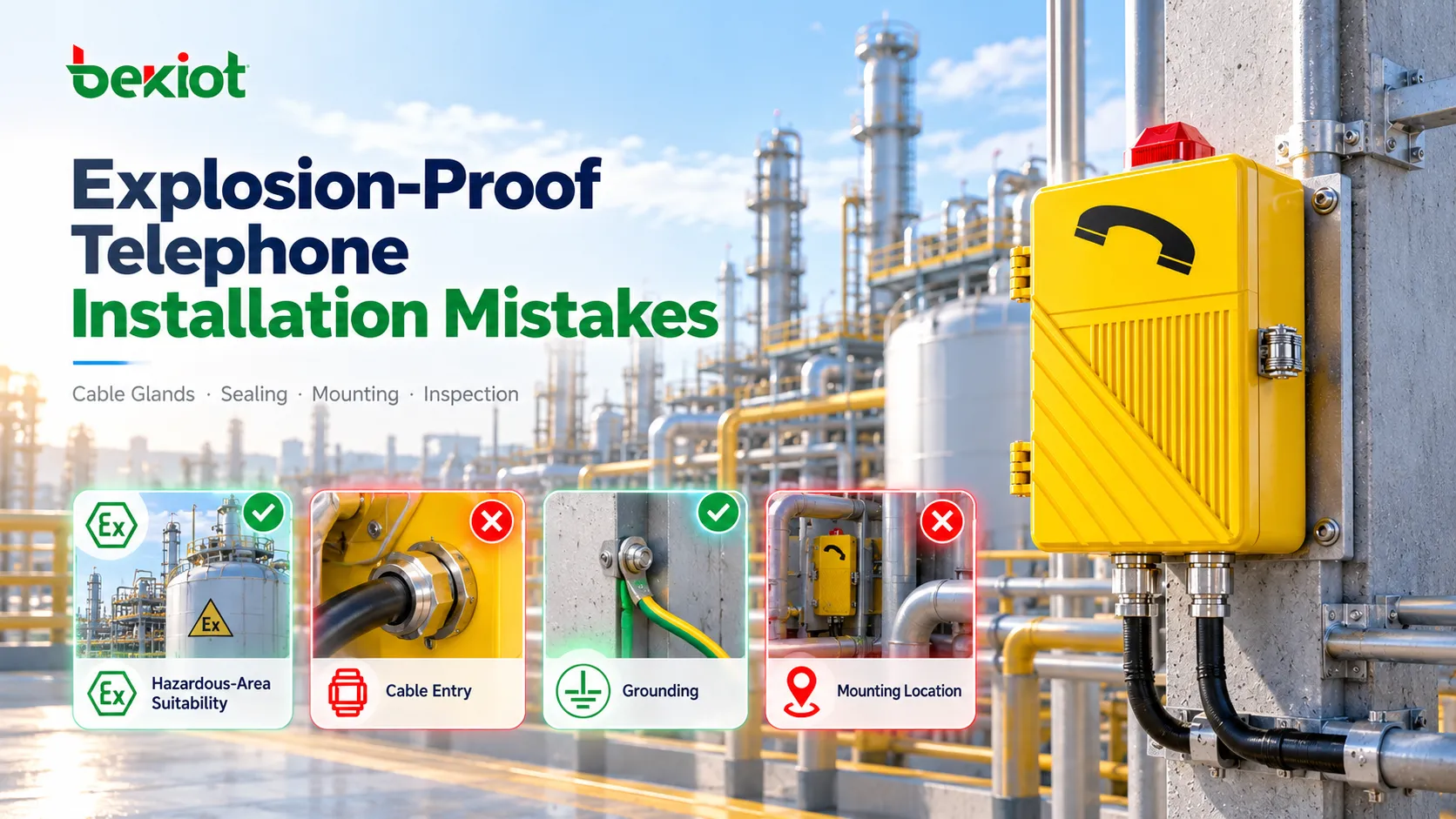
A weatherproof telephone is not automatically explosion protected. Where the site assessment requires Ex equipment, verify the complete terminal, accessories, certification scope and installation method against the applicable jurisdiction and classified location.
A Waterproof Endpoint Example
The EX-BT27 product page lists SIP 2.0, IP66, IK10, PoE, configurable off-hook hotline dialing, automatic answering, adjustable audio levels and a stated operating range of -40°C to +60°C. These are selection inputs, not proof of intelligibility or mining approval. Confirm the supplied configuration, power options and installation documentation for the project; the model prefix alone proves no Ex certification.
EX-BT27 industrial waterproof telephone specifications
Build a Resilient SIP Communication Path
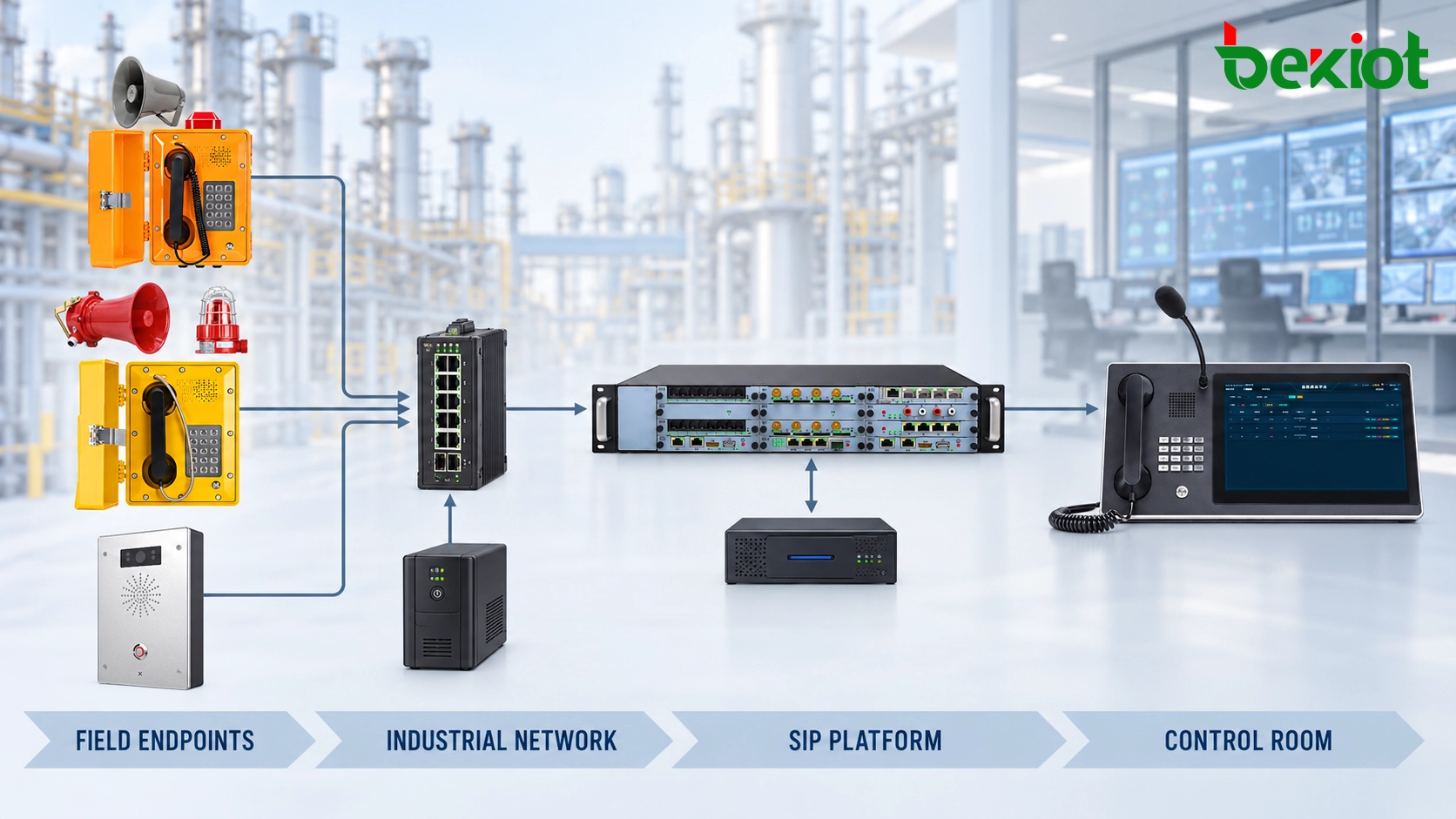
A typical system joins field telephones, managed switches, a SIP server or IP PBX, operator consoles and optional recording, paging or radio interfaces. Off-hook dialing and auto-answer may be endpoint functions; queues, priority policy, escalation, recording and location display usually depend on platform configuration or integration. SIP support alone does not guarantee every dispatch feature.
Define point-to-point calls, hotlines and authorized paging zones.
Agree emergency priority, busy handling, transfer and unanswered-call destinations.
Test gateway and platform interoperability for each required function.
Verify Signaling and Audio Separately
SIP controls sessions; RTP commonly carries voice. Successful registration does not prove that microphones, receivers or both media directions work. Check routing, firewalls and address translation across local subnets, operational zones and WAN links. Measure delay, jitter and loss under representative load, and verify QoS treatment throughout the path.
Power and Failure Recovery
PoE transfers dependence to the supplying switch. Include switches, uplinks, servers, gateways and operator positions in backup-power planning. Determine usable runtime under the actual load and battery condition. Use failure analysis to choose diverse routes, redundant equipment or alternate control positions; two cables sharing one vulnerable route do not provide route diversity.
Position Call Points Around Real Workflows
Choose locations by access time, hazards and worker routes rather than floor area alone. Avoid approaches that cross machinery or traffic lanes. Evaluate entrances, maintenance platforms, tunnel cross passages, refuge points and emergency exits, while following applicable site rules.
Move terminals away from fan outlets, motors and reflective corners where possible. A barrier or booth may improve conditions more than added amplifier power, but must preserve safe access, visibility and evacuation routes. Provide identifiable signs and suitable lighting.
Use lift-to-call or one-button behavior where an emergency task requires it. Map the extension to a meaningful location such as “Conveyor Line 2 East.” Agree no-answer escalation with the operations team and test the actual backup destination; location display depends on maintained platform records.
Define Measurable Acceptance Criteria
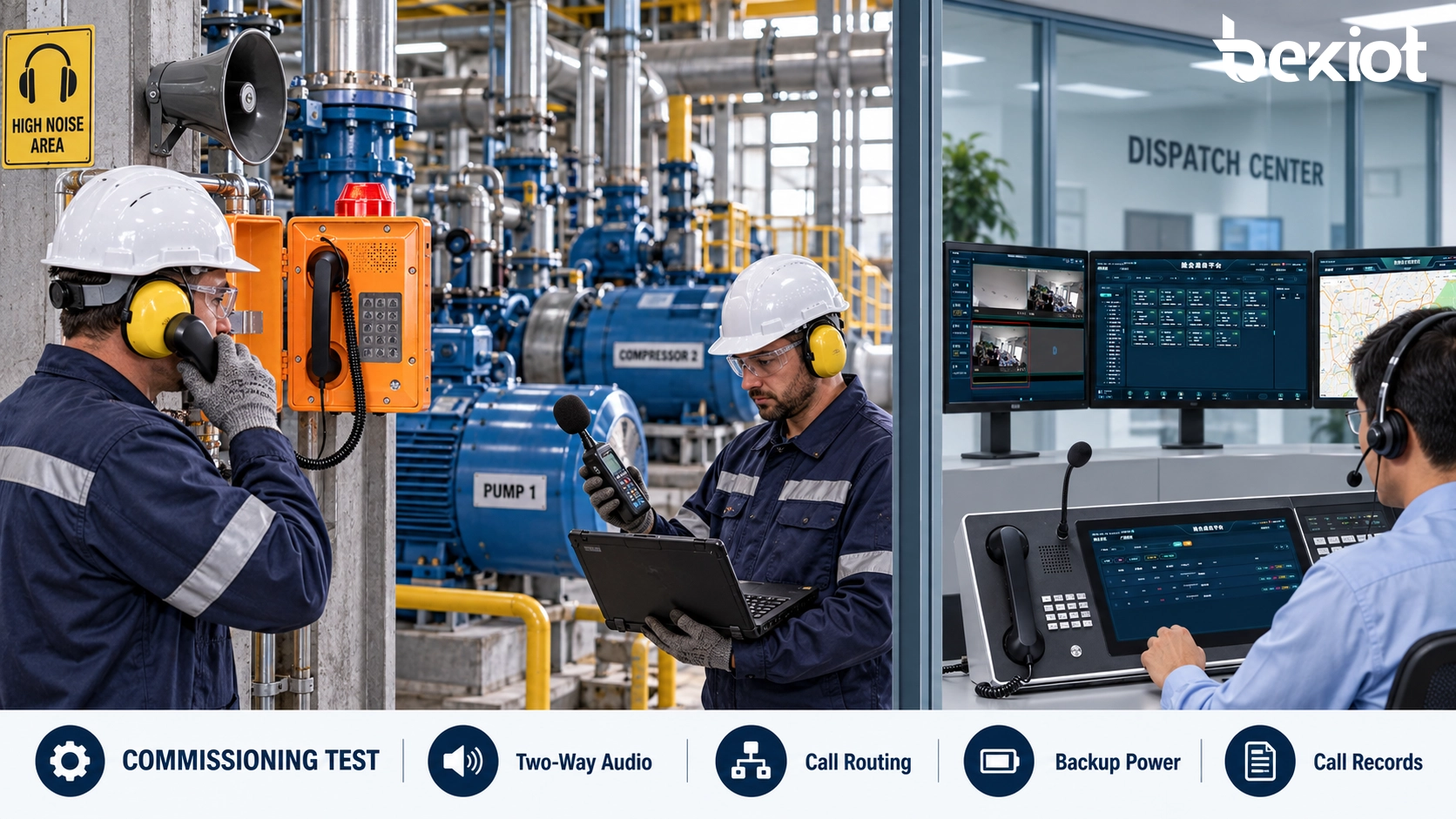
Agree test phrases and acceptance criteria before commissioning. Include equipment identifiers, numbers, locations and instructions, then have the listener repeat the message. Test both directions under representative noise with normal PPE. A test tone proves an audio path, not message comprehension.
| Test area | Required verification |
|---|---|
| Call initiation and routing | Keypad, hotline, emergency call, busy handling, transfer and no-answer escalation. |
| Alert and speech | Detectable alerts and correctly repeated phrases at normal user positions, without compromising hearing protection. |
| Network and media | Two-way RTP and stable calls across required routes under representative traffic. |
| Power and failure | Specified backup duration, controlled link or server failure, fallback and restoration. |
| Installation and records | Sealing, mounting, location identity, timestamps, alarms and authorized access to logs or recordings. |
For more detail on repeatable listening checks, see the guide to industrial telephone voice-quality testing.
Maintain Availability After Handover
Set inspection frequency according to exposure and operational importance. Check enclosure, mounting, glands, cords, microphone openings, keys, hook switch, indicators and real two-way calls. A local dial tone or online status is insufficient.
Maintain extension and location records, SIP accounts, IP addresses, VLANs, switch ports, routing rules and firmware versions. Back up approved configurations and retest after moves, network changes or repairs. Stock suitable handsets, cords, glands and a configured replacement terminal according to replacement lead time.
FAQs
Can industrial telephone calls be recorded?
Yes, where a compatible platform or recording integration provides that function. Define authorized access, retention and applicable privacy requirements before enabling it.
Can several plants share a central platform?
Yes. Plan numbering, site names, bandwidth, security and WAN-loss behavior so each location remains identifiable and required local communication can continue.
Can telephones share infrastructure with office computers?
They can, subject to the site's network design. Managed VLANs, access controls and QoS help traffic management and fault isolation, but require configuration and verification.
Does every noisy factory need explosion-proof telephones?
No. Noise and weather exposure do not establish an explosion hazard. The formal site assessment and applicable rules determine whether Ex equipment is required.
References