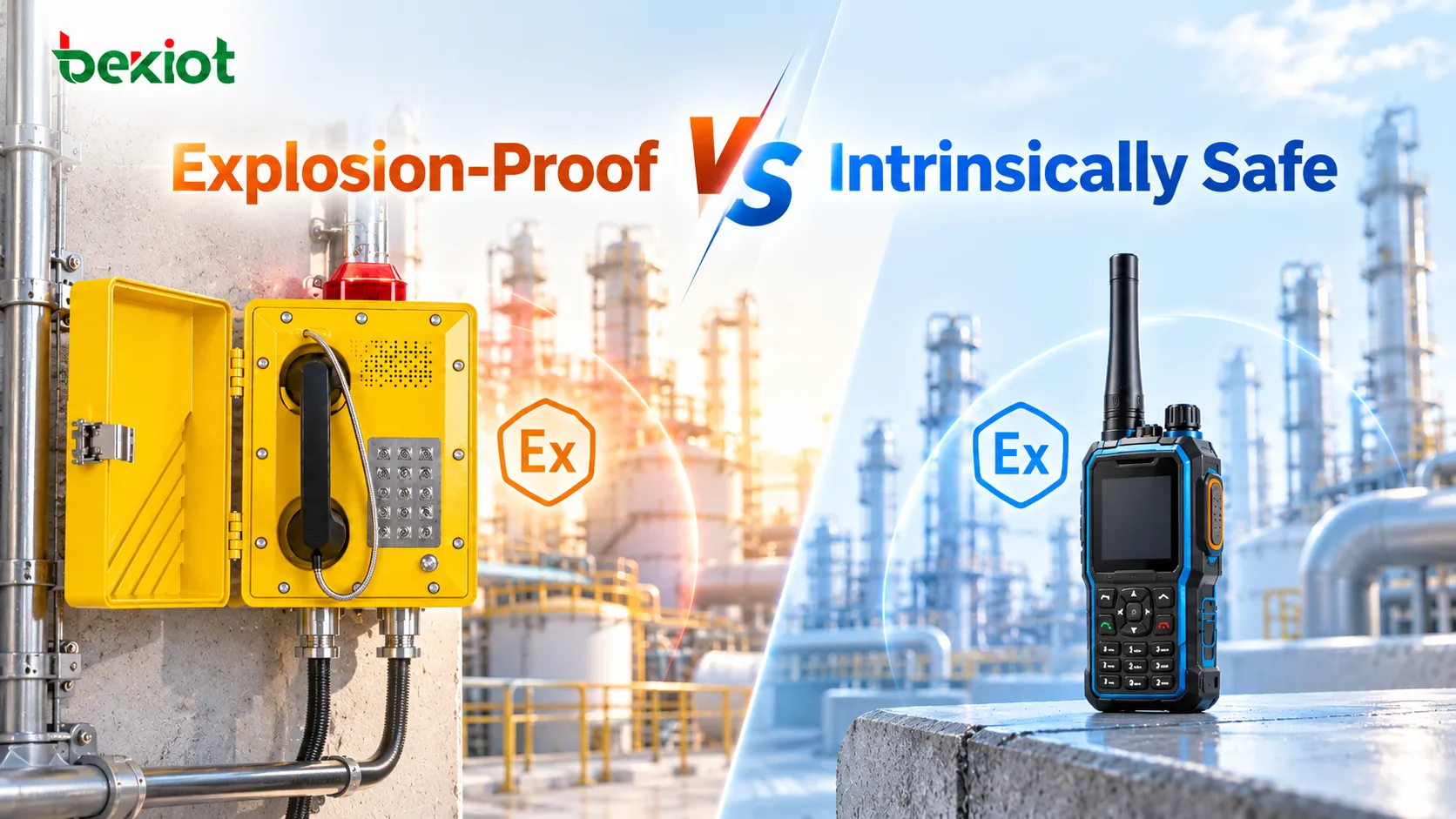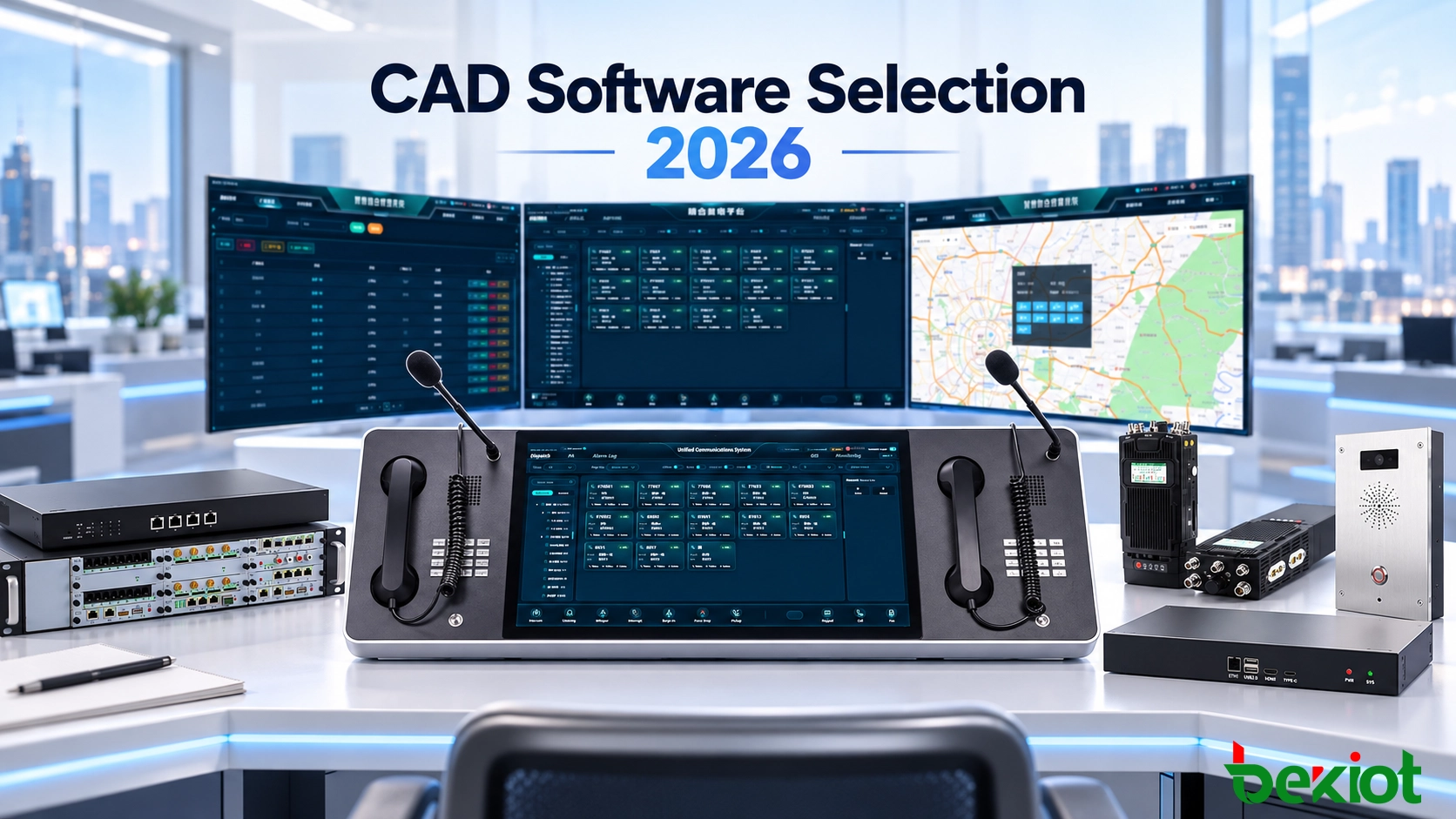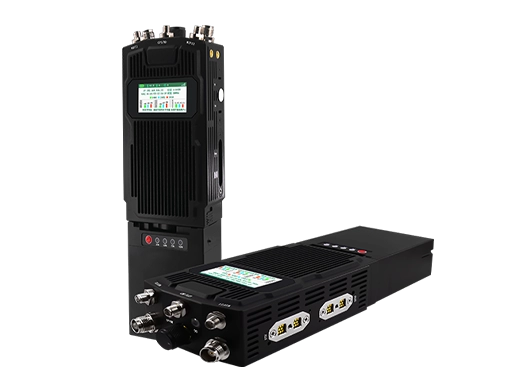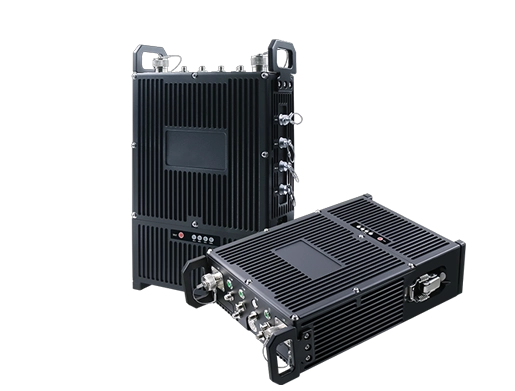


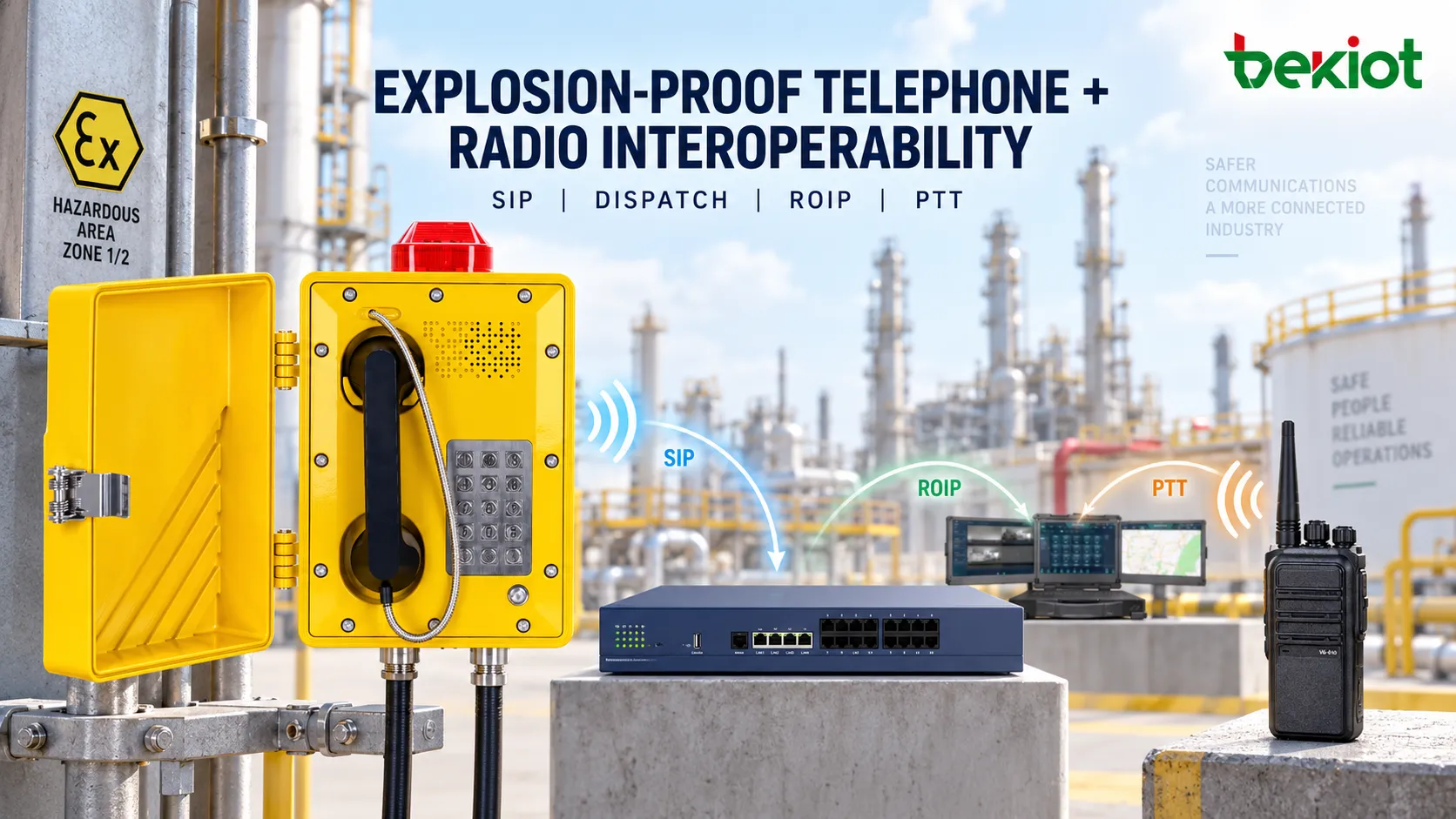
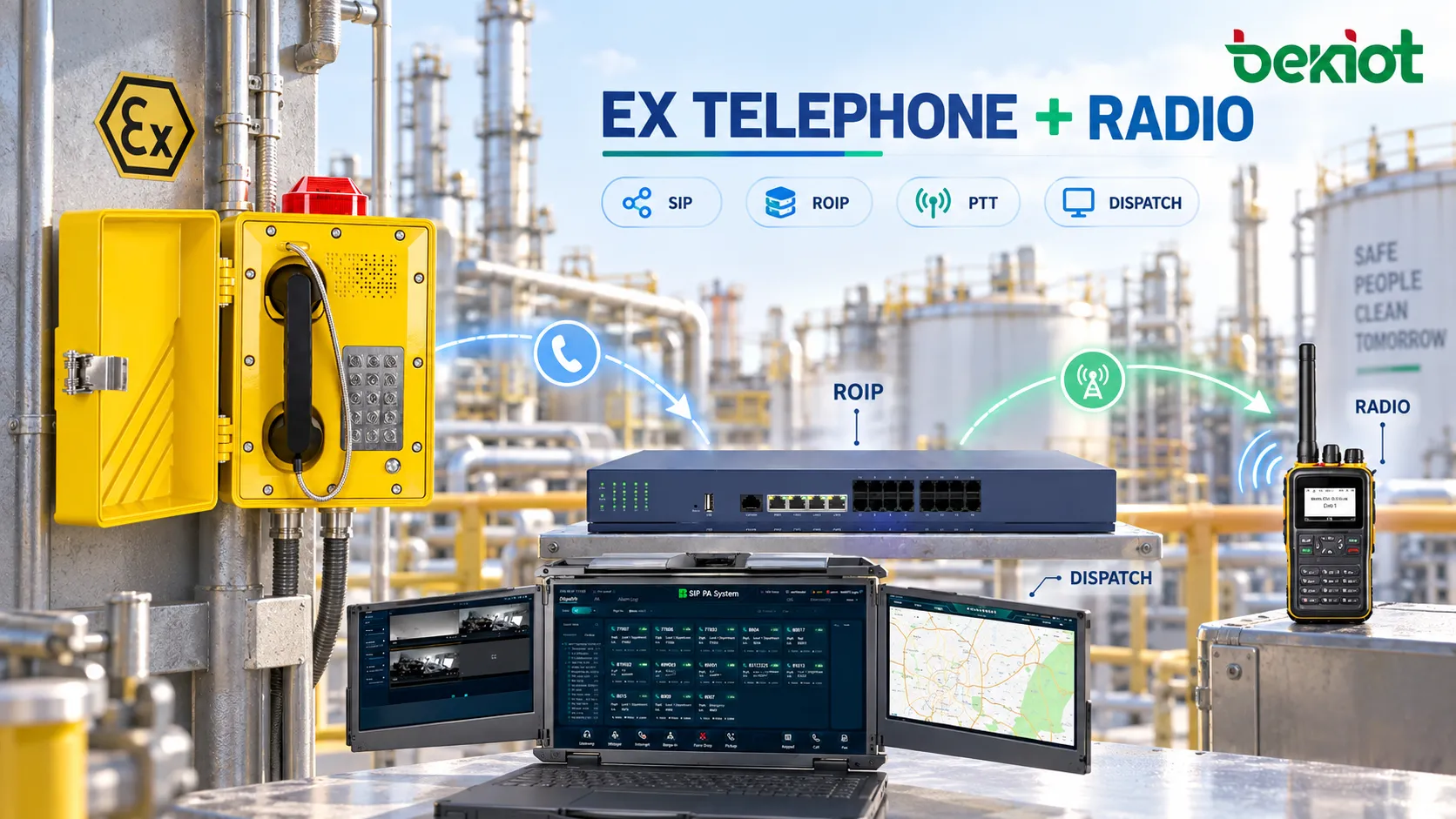
Explosion-proof telephones provide fixed calling points in hazardous areas, while portable and mobile radios follow field teams. They can communicate through a compatible telephone platform, RoIP gateway and radio interface. The integration connects voice and transmit control; it does not turn the telephone into a radio or extend its Ex certification to other equipment.
What changes between telephone and radio communication?
A SIP telephone normally establishes a full-duplex call through a PBX or dispatch server, with voice carried over RTP. Radio users commonly share a channel or talk group and press PTT to transmit, then release it to receive. Some radio systems support other modes, so confirm the actual service rather than treating every DMR, P25 or TETRA call as identical.
The integration must map a telephone destination to a radio resource and coordinate the speaking direction. On a control-radio interface, PTT requests transmission; COR, COS or another receive-detection signal can indicate received traffic. These signals and their electrical characteristics depend on the radio and gateway.
Choose direct access or dispatcher control
A telephone destination mapped to a radio resource
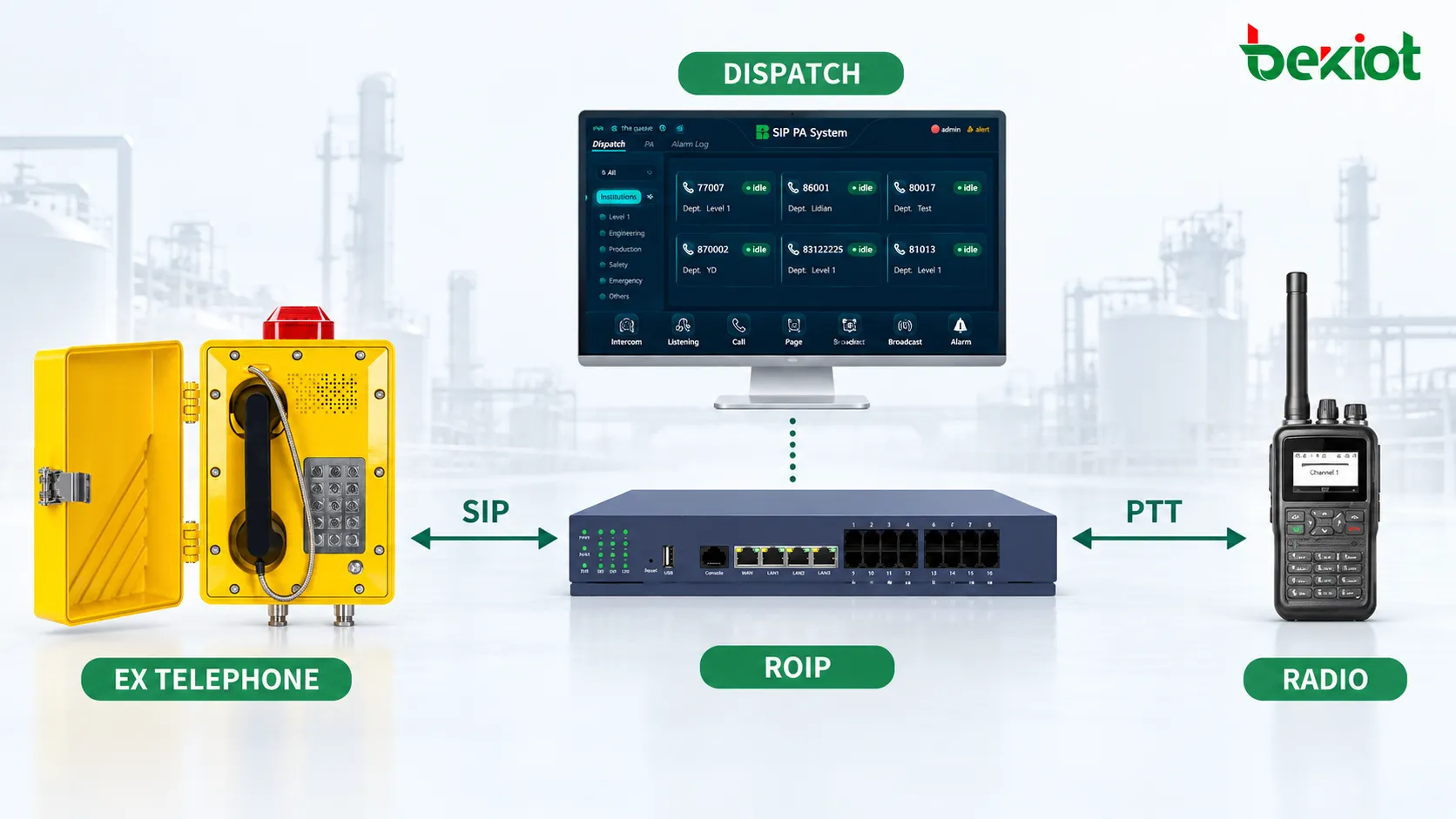
With supported SIP routing, an extension can represent a gateway radio channel. A compressor-room telephone might call the maintenance group using a fixed destination. The PBX, gateway or integration layer must provide the required routing and PTT behavior; SIP support alone does not guarantee either function.
A dispatcher connects the two systems when needed
The field telephone can instead call a dispatcher, who selects the appropriate maintenance, security or emergency radio resource. A temporary bridge can include the caller when required. This gives the operator control over what enters a shared radio channel and avoids continuously occupying resources with an unnecessary permanent bridge.
Location labels and channel names are platform functions that require configuration. A reliable extension-to-location mapping can identify a fixed caller, but it should be checked against the installation record rather than assumed from caller ID.
Follow the audio and control paths
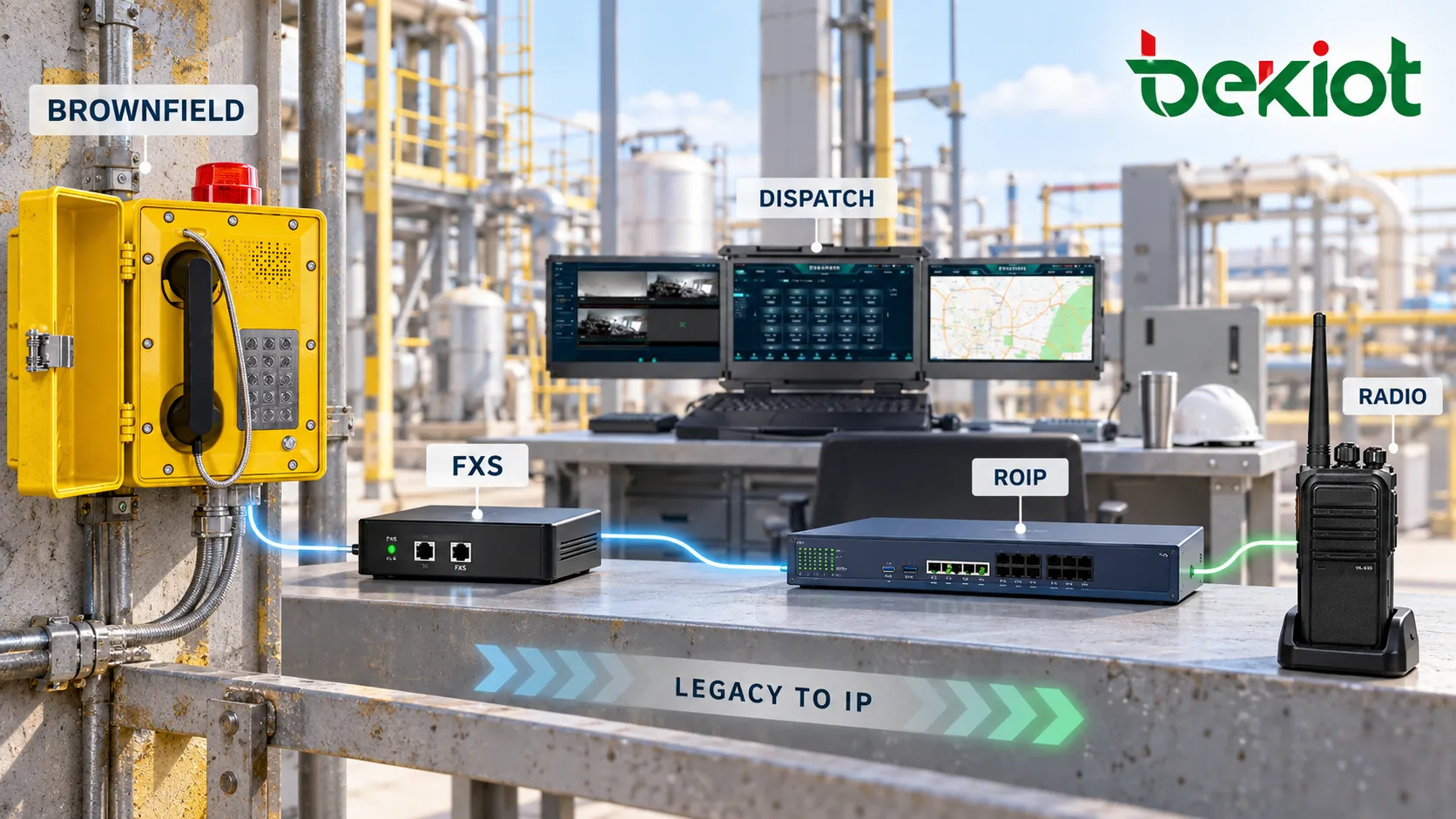
In a common control-radio arrangement, telephone RTP reaches the RoIP gateway through the IP network and telephone platform. The gateway supplies compatible audio and PTT control to a radio; that radio performs the RF transmission. Received radio audio returns through the gateway to the telephone, with receive status used where supported.
This is audio and control interworking, not automatic translation of DMR, P25 or TETRA air interfaces. Talk-group identity, messaging, encryption and native digital signaling need separately supported interfaces. An audio bridge does not preserve all radio metadata or guarantee end-to-end encryption.
Confirm the exact control-radio model, approved accessory interface and channel or talk-group operation.
Verify audio wiring, level, impedance and isolation, including whether the interface is 2-wire or 4-wire.
Check PTT polarity and electrical limits, receive-detection behavior and the response to disconnected control wiring.
Adapt full-duplex speech to PTT operation
Define who may key the radio, what happens while it is receiving, and when transmission ends. Dispatcher PTT is one option. Telephone keys, DTMF or integration commands are alternatives only when the terminal and complete system support them; they are not native capabilities of every explosion-proof telephone.
Voice activity detection can key PTT automatically, but pumps, ventilation and alarms may trigger it. Test thresholds in representative noise. Busy indication and transmit inhibition also require supported receive status and control logic; they do not automatically prevent every RF collision.
Adjust PTT lead time or buffering so the first word reaches the radio after the transmit path is ready. Adjust release delay so the final syllable is retained without unnecessarily holding the channel. Verify rapid turn-taking and recovery from a stuck transmit request using the actual equipment.
Integrate analog telephones without bypassing Ex requirements
An existing analog telephone may connect through a compatible FXS voice gateway to the SIP or dispatch platform, while the RoIP gateway interfaces with the existing radio. Check loop voltage, ringing, line length and any required protection or isolation. FXS compatibility does not prove hazardous-area suitability.
Place ordinary gateways, servers and control radios outside classified areas unless their own approval and installation permit otherwise. Keep the telephone, power supply, cable entries, accessories and wiring within the certified design. Intrinsically safe circuits need the required associated apparatus and system verification; an ordinary FXS port is not an intrinsic-safety barrier. Review the telephone nameplate and certificate scope before changing field connections.
Control audio quality and shared failure points
Evaluate codec compatibility, transcoding, network delay, jitter and packet loss across the complete route. G.711 commonly offers broad compatibility with relatively low codec delay, while compressed codecs may save bandwidth at the cost of additional processing. Select a supported path and validate QoS under congestion; QoS cannot repair an unavailable link. Calibrate transmit and receive levels separately to avoid weak speech, clipping and distortion.
Identify failures of power, PBX, dispatch server, IP link, gateway and control radio. Choose backup power, redundant paths or spare equipment according to the required service continuity, and preserve a usable local fallback. Emergency priority, channel permissions and failover are system design choices that must be supported and tested.
Confirm that recording captures both telephone and radio audio, with synchronized event timestamps where required. Apply access and retention rules. A shared radio channel may expose telephone audio to other listeners, and a bridge may pass unrelated radio traffic into the call.
Commission both directions under site conditions
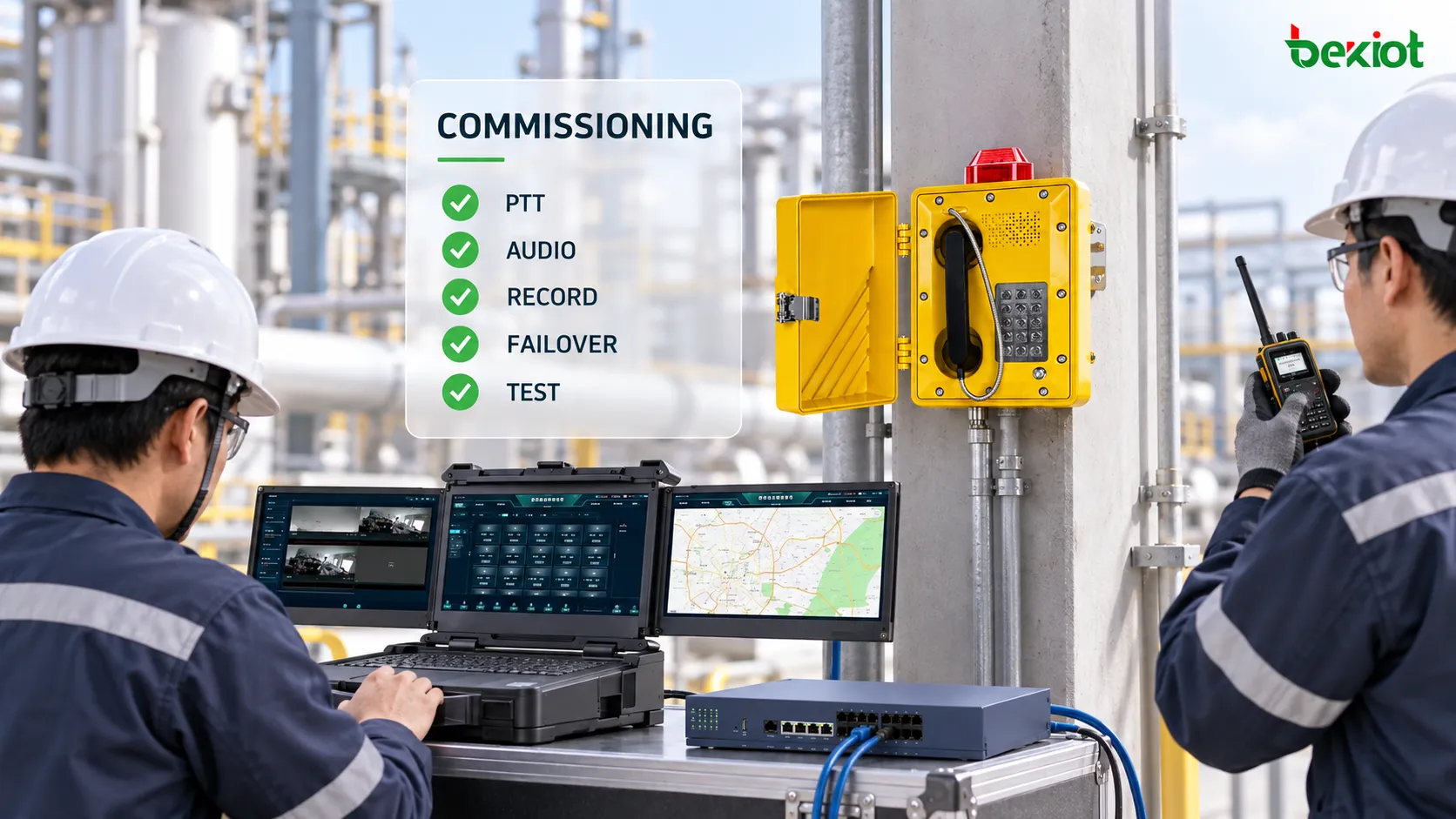
Call the intended radio resource and verify correct routing, authorization, PTT operation and intelligibility without first-word clipping.
Transmit back from a radio and verify receive detection, return audio, busy behavior and rapid changes of speaker.
Check dispatcher resource selection, caller location, temporary bridge release and recordings from both directions.
Test the specified power, network, server and gateway failures, plus loss of the control radio; verify recovery and the fallback procedure.
Repeat intelligibility checks with representative noise, radio coverage and network loading, using equipment and work procedures approved for the area.
FAQs
Can the telephone register directly to a RoIP gateway?
Only if that gateway supports the required registrar or peer arrangement. Many deployments use a PBX to manage telephones and route calls to gateway resources. A SIP interface is not proof that a gateway replaces a PBX.
Can one gateway reach several radio groups?
Possibly, within its supported channels, connected radios and routing design. A basic audio interface does not automatically select arbitrary digital talk groups.
Can radio users dial telephone numbers?
That needs supported digit entry, signaling and authorized telephone routing. A preset hotline may be more practical for radios without a keypad. See how a two-way radio calls a phone number for that distinct call direction.
Does adding a gateway change the telephone's Ex approval?
A central integration does not itself certify or recertify the field telephone. Any changed power, wiring, accessory or enclosure arrangement must remain within the certificate and installation requirements and be reviewed by competent personnel.
Technical references
IETF RFC 3261 defines SIP session control, while RFC 3550 defines RTP media transport. Neither guarantees a particular gateway’s radio-control functions. IECEx installation guidance explains equipment selection, certificate conditions and installation documentation.